I've been working for years on various iterations of a piece that should describe how the paradigm shift we're living through calls for a rethinking of the skills that we need - and thus also points to the need to rethink our educational curriculum.
So, I've put the latest version on my website - and yes, it's long: 20 pages, but I actually think it is important stuff.
Here's an excerpt, from the beginning:
Society is making its way through a profound change. We are leaving the industrial age and entering a new paradigm - one which we could name the network society.
The main characteristic of this is connectivity. Humans, machines, cultures and economies are connected ever closer, more often, in more detail and across greater distances. Developments in completely different realms are increasingly influencing and interfering with each other.
Acceleration is another characteristic. As each new technical development helps us taking the next step even faster even change itself is accelerating.
The network society offers us countless new opportunities - but at the same time it confronts us with a demand for new competences. Clearly, the type of work that we will be making our living from in a globally connected hi-tech world will be very different from the work which our welfare society was built upon.
We need a new approach, one that's suitable for the new rules of the game. We need a different perception of the mechanisms which drive change - and we need to weed out old concepts and structures that have become irrelevant and which often end up as barriers to necessary change.
All of this implies a deep cultural shift in attitude and understanding of learning, innovation and action - a shift that's needed all the way from kindergartens to retirees.
In primary schools one uses the term ”literacies”, to describe the basic skills that are necessary in order to get by in society. In Denmark the law emphasizes 5 literacies: reading, writing, math, English as second language, and basic IT skills. If you lack one or more of these, you will experience that the doors to further learning are shut.
But what's considered basic literacies obviously changes as the conditions in society change. As we shift from the industrial society to a networked society we will need to acquire a number of new, basic competences to supplement the old literacies.
Put briefly, these new competencies are about understanding the way in which globally connected, complex, dynamic systems work. The internet, international politics, stock markets, or living systems, like our body… These are the sort of complex systems that we need to engage with, and our future welfare will depend on our ability to do so in smart ways.
We will need a completely internalized understanding of the mechanisms that drive such systems. At the moment it may sound very abstract, but concepts like evolution, non-linearity, feedback, self organization and ecology will increasingly be crucial to us in order to asses situations correctly and to act intelligently in relation to the forces that shape our circumstances.
Saturday, July 28, 2007

Thursday, July 12, 2007
Goodbye sunday paper

A couple of months ago I decided to cancel my sunday newspaper subscription. Somehow it seemed that they never really printed anything in there worth reading anyway. It was nagging me to recieve all of that paper which I basically just wasted time flipping through and discarding. The decisive moment came when they started to deliver the paper wrapped in plastic.
So my life is little bit lighter, and frankly I haven’t missed it at all.
The great carbon cover up, part 2
In Denmark we like to pride ourselves that as a nation we have decoupled economic growth and the use of fossil fuels.
But in fact our C02 emission modesty looks quite different if we include the emissions from the Danish shipping industry. A number of the worlds largest shipping companies are Danish – most notably Maersk.
It turns out that the combined emissions from the Danish fleet of ships amount to 25% of the total Danish emissions. Only the shipping emissions don’t show up in the usual statistics, because fuel for international transport is exempt from the Kyoto protocol – and from taxation.
But in fact our C02 emission modesty looks quite different if we include the emissions from the Danish shipping industry. A number of the worlds largest shipping companies are Danish – most notably Maersk.
It turns out that the combined emissions from the Danish fleet of ships amount to 25% of the total Danish emissions. Only the shipping emissions don’t show up in the usual statistics, because fuel for international transport is exempt from the Kyoto protocol – and from taxation.
The great carbon cover up, part 1
In Denmark we are proud to have committed to the Kyoto goals of reducing our emissions. It’s still very much doubtful that we will in fact hit the target, but at least we feel we are doing something.
However, you never hear any discussion of the impacts of our agricultural industry on the greenhouse effect.
There are 5 mio. People living in Denmark, but at any time there is also about 13.5 mio. Pigs. Annually, about 25 mio. Pigs are slaughtered in Denmark.
The Average Danish person emits around 10 tons of carbon dioxide annually. According to The Economist, ”every year the average sow and her piglets produce 9.2 tonnes of carbon-dioxide equivalent through the methane emissions from their effluent”.
In that case, it seems that the true Danish carbon emissions are about 3 times the official figure.
Apart from the damaging effect of all the methane that these pigs produce, it also takes considerable energy to raise those 25 mio. Pigs annually.
Obviously, you lose a lot of calories when you raise meat, somewhere between a factor 5 to 10, as far as I have been able to research.
Pigs are slaughtered at the age of 4-5 months, when they have reached a weight of about 100 kilo.
Even though Denmark is a wonderfully fertile country we cannot produce enough to feed those pigs, so a considerable part of this is shipped in from Brazil, Argentina and other soy producers. It takes a lot of energy to grow that soy, for fertilizers, machinery and transportation. Fertilizer is produced from natural gas and transportation fuel is almost all fossil as well.
(To make matters worse, the land used for producing soy in Brazil and Argentina is partly forests that have been cleared – and thus no longer help to stabilize the climate.)
Finally, 80% of the meat is exported, adding more transportation and more emissions.
Oh, did I forget cows? Denmark is a big dairy producer. We have 650.000 cows – and cows fart too.
However, you never hear any discussion of the impacts of our agricultural industry on the greenhouse effect.
There are 5 mio. People living in Denmark, but at any time there is also about 13.5 mio. Pigs. Annually, about 25 mio. Pigs are slaughtered in Denmark.
The Average Danish person emits around 10 tons of carbon dioxide annually. According to The Economist, ”every year the average sow and her piglets produce 9.2 tonnes of carbon-dioxide equivalent through the methane emissions from their effluent”.
In that case, it seems that the true Danish carbon emissions are about 3 times the official figure.
Apart from the damaging effect of all the methane that these pigs produce, it also takes considerable energy to raise those 25 mio. Pigs annually.
Obviously, you lose a lot of calories when you raise meat, somewhere between a factor 5 to 10, as far as I have been able to research.
Pigs are slaughtered at the age of 4-5 months, when they have reached a weight of about 100 kilo.
Even though Denmark is a wonderfully fertile country we cannot produce enough to feed those pigs, so a considerable part of this is shipped in from Brazil, Argentina and other soy producers. It takes a lot of energy to grow that soy, for fertilizers, machinery and transportation. Fertilizer is produced from natural gas and transportation fuel is almost all fossil as well.
(To make matters worse, the land used for producing soy in Brazil and Argentina is partly forests that have been cleared – and thus no longer help to stabilize the climate.)
Finally, 80% of the meat is exported, adding more transportation and more emissions.
Oh, did I forget cows? Denmark is a big dairy producer. We have 650.000 cows – and cows fart too.
Friday, March 16, 2007

Tuesday, March 06, 2007
"Bright green" - what does it mean?
I kinda like the term ”bright green” that the folks at worldchanging.com use to describe their vision of a sustainable future. One of the problems with words like sustainable or organic is that so many interpretations have been heaped on them. They’re tired, they’ve lost their power to engage, and what’s worse, in many cases they actually turn off people, who may be worried about the environment and wish to turn away from a destructive life style, but don’t want to be part of the sustainability brigade.
But what might ”bright green” mean?
Here’s my list – please add to it.
I see bright green as a a strategy for meeting our needs in a way that makes good use of facts, science and technology. Bright green solutions are robust and they can achieve massive, industrial scale. They have reliable outcomes, documented effects, it’s understood how they work.
They are transparent. They enable users to become participants in optimizing their outcome. They invite users to act in a responsible way – to become co-creators rather than passive consumers.
Obviously, money is not the only value in life, but the spread Bright green products and solutions should be driven by market forces. They have to be attractive and make economical sense. They may be supported by regulation, but basically they should not be chosen out of guilt or good will, but based on competive merits.
Bright green solutions are holistic and complex. They are not discrete, local fixes. They take the larger context into account, and this can be done by using sensors, networks and by approaching reality as an ecosystem of interconnected and interdependent factors.
...to be continued
But what might ”bright green” mean?
Here’s my list – please add to it.
I see bright green as a a strategy for meeting our needs in a way that makes good use of facts, science and technology. Bright green solutions are robust and they can achieve massive, industrial scale. They have reliable outcomes, documented effects, it’s understood how they work.
They are transparent. They enable users to become participants in optimizing their outcome. They invite users to act in a responsible way – to become co-creators rather than passive consumers.
Obviously, money is not the only value in life, but the spread Bright green products and solutions should be driven by market forces. They have to be attractive and make economical sense. They may be supported by regulation, but basically they should not be chosen out of guilt or good will, but based on competive merits.
Bright green solutions are holistic and complex. They are not discrete, local fixes. They take the larger context into account, and this can be done by using sensors, networks and by approaching reality as an ecosystem of interconnected and interdependent factors.
...to be continued
Tuesday, February 20, 2007
Davos highlight
I didn’t get to the World Economic Forum in Davos this year either. But then again, their website is certainly a very good substitute. I can recommend taking a good look around, there is an amazing amount of good information – among them a great deal of very instructive slides prepared by PricewaterhouseCoopers that capture a number of central global predicaments in a nutshell.
A good part of the speeches are available as podcasts, although I would say that to me they were not nearly as interesting as the sessions last year.
The one that captured me the most was the closing remarks by Tony Blair. It’s great to hear someone with ten years of experience as one of the top global players who insists on a vision of better world and even manages to stir up some optimism. I realize there’s a lot of Blair-fatigue in the UK, but I found his speech quite constructive.
 Here’s a couple of quotes:
“What is really happening is that nations - even the most great - are realising that they cannot pursue their narrow national interests without invoking broader global values. They are obliged to recognise that interdependence is the defining
characteristic of the early 21st century world”.
“Above all, nations find that they need to confront and deal
with challenges that simply do not admit of resolution without powerful alliances of other nations. And every nation, even the most powerful, is obliged to find such alliances or find their own interests buffeted and diminished.
That is why we call it interdependence. It is the ultimate joining together of selfinterest and community interest. Afghanistan was a failed state, its people living in misery and poverty but in days gone by it would have stayed that way without the world much noticing. September 11th brought it to our notice in the most unforeseen but catastrophic way. Look how the world has changed because of it.
We know Africa’s plight is shameful in a world of plenty. But I have never shrunk from confessing another motive. I believe if we let Somalia or Sudan slip further into the abyss, the effect of their fall will not stay within their region never mind their nation. I will argue for the presence of peace in Palestine on its own terms; but there is no question that its absence has consequences on the streets of cities in Britain amongst people who have never been near Gaza or the West Bank.
And, of course, there is climate change. Assume even a possibility of its threat being real. It would be madness not to act to prevent its realisation – just as a precaution. Its challenge is the supreme expression of interdependence. America and China, even if they had no other reason for a relationship and they have many, would need one simply for this alone".
Blair further speaks about his frustrations that often action is hampered not by lack of political will but because the instruments we have to take decisions and act at a global level are inadequate:
"Global purpose, underpinned by global values requires global instruments of effective multilateral action.
A UN Security Council without Germany, Japan, Brazil or India, to say nothing of any African or Muslim nation, will, in time, not merely lose legitimacy in the eyes of the world, but seriously inhibit effective action. By all means let us have some form of bridging mechanism – perhaps semi-permanent status without a veto – to a reformed Council; but get it done. Likewise with reform within the UN – greater power to the Secretary General, merging agencies, one UN organisation incountry. But reform now has to happen.
There is a powerful case for merging the IMF and World Bank and for increasing the influence of the developing countries within them.
The G8 is already well on its way to metamorphosis into G8 +5. At G8 +5, it can be a forum for agreement between the most powerful nations with a true modern global reach.
But sooner or later, the metamorphosis should be complete.
We need to make the regional blocs more effective.
I strongly believe in changing the rules of the EU to build efficacy in Europe'spower. The EU at 27 cannot operate within the system used for an EU of 15 countries.
It would hugely help the cause of Africa if the AU became a strongly and cohesive voice and instrument of Africa's interests".
A good part of the speeches are available as podcasts, although I would say that to me they were not nearly as interesting as the sessions last year.
The one that captured me the most was the closing remarks by Tony Blair. It’s great to hear someone with ten years of experience as one of the top global players who insists on a vision of better world and even manages to stir up some optimism. I realize there’s a lot of Blair-fatigue in the UK, but I found his speech quite constructive.
 Here’s a couple of quotes:
“What is really happening is that nations - even the most great - are realising that they cannot pursue their narrow national interests without invoking broader global values. They are obliged to recognise that interdependence is the defining
characteristic of the early 21st century world”.
“Above all, nations find that they need to confront and deal
with challenges that simply do not admit of resolution without powerful alliances of other nations. And every nation, even the most powerful, is obliged to find such alliances or find their own interests buffeted and diminished.
That is why we call it interdependence. It is the ultimate joining together of selfinterest and community interest. Afghanistan was a failed state, its people living in misery and poverty but in days gone by it would have stayed that way without the world much noticing. September 11th brought it to our notice in the most unforeseen but catastrophic way. Look how the world has changed because of it.
We know Africa’s plight is shameful in a world of plenty. But I have never shrunk from confessing another motive. I believe if we let Somalia or Sudan slip further into the abyss, the effect of their fall will not stay within their region never mind their nation. I will argue for the presence of peace in Palestine on its own terms; but there is no question that its absence has consequences on the streets of cities in Britain amongst people who have never been near Gaza or the West Bank.
And, of course, there is climate change. Assume even a possibility of its threat being real. It would be madness not to act to prevent its realisation – just as a precaution. Its challenge is the supreme expression of interdependence. America and China, even if they had no other reason for a relationship and they have many, would need one simply for this alone".
Blair further speaks about his frustrations that often action is hampered not by lack of political will but because the instruments we have to take decisions and act at a global level are inadequate:
"Global purpose, underpinned by global values requires global instruments of effective multilateral action.
A UN Security Council without Germany, Japan, Brazil or India, to say nothing of any African or Muslim nation, will, in time, not merely lose legitimacy in the eyes of the world, but seriously inhibit effective action. By all means let us have some form of bridging mechanism – perhaps semi-permanent status without a veto – to a reformed Council; but get it done. Likewise with reform within the UN – greater power to the Secretary General, merging agencies, one UN organisation incountry. But reform now has to happen.
There is a powerful case for merging the IMF and World Bank and for increasing the influence of the developing countries within them.
The G8 is already well on its way to metamorphosis into G8 +5. At G8 +5, it can be a forum for agreement between the most powerful nations with a true modern global reach.
But sooner or later, the metamorphosis should be complete.
We need to make the regional blocs more effective.
I strongly believe in changing the rules of the EU to build efficacy in Europe'spower. The EU at 27 cannot operate within the system used for an EU of 15 countries.
It would hugely help the cause of Africa if the AU became a strongly and cohesive voice and instrument of Africa's interests".
Friday, February 16, 2007
The World Changing book
 This is to recommend that you read ”World Changing – a user’s guide to the 21st. century”. It weighs a massive 1700 grams, and I have just carried it in my backpack for 5 weeks of travelling – but it was worth it.
”World Changing” is not exactly a page turner, it’s more like a catalogue of all the various activities and issues that relate to this vague dream and hope so many of us share of creating what the folks at Worldchanging call a ”bright green future”. In fact, you could easily compare to the good ole Whole Earth catalogue.
Even for professional eco-information analysts this should provide a good deal of information and inspiration.
Obviously it gets outdated at the speed of technology, but just now I can’t think of a better way to an overview of our threats and possibilities. For the latest information you can always visit the worldchanging website, where most of the content of the book originated. These people are doing great and important work!
Thursday, February 15, 2007

Wednesday, February 14, 2007
The incredible morphing toilet paper meme

Here's yet another incarnation of the folded toilet paper meme - this one's from Ideal Beach resort, Mahabalipuram, Southern India.
What's next - origami?
Tuesday, December 19, 2006
What would it mean to teach innovation in schools?
Innovation should not be a separate discipline but rather an approach that is an integral part of all subjects.
There is no doubt that if you support learning processes that are modern, efficient and which invite students to be creative in their daily work – this will help the innovation perspective.
But what is it then specifically that distinguishes ”normal”, good teaching learning methods from learning with an eye to innovation?
In my opinion the crucial factor would be that in learning for innovation, the world is presented as something which is under continuous change – a development each of us has the possibility to affect.
We live in a time in which we increasingly will be expected to act and develop in relation to the contexts we are part of. Thus, we should not merely accept the facts and circumstances that we are presented with as static, but rather see them as stages of a continued process.
This requires that one understands the history that preceded the present, and that one understands the forces that are driving development.
It implies that one decides if a situation is satisfactory and good, or if it should be changed.
And it requires that one feels relatively at ease dealing with uncertainty and change.
This all means that teaching innovation would have 5 distinct assumptions integrated:
- Understanding the world as being under continuous change
- Understanding that each of us has the possibility and is under demand to participate in the further development
- A critical, assessing approach to the existing conditions
- Knowledge of the tools that are necessary in order to act in relation to the development
- A physical environment that can be changed and which invites its users to create and experiment
There is no doubt that if you support learning processes that are modern, efficient and which invite students to be creative in their daily work – this will help the innovation perspective.
But what is it then specifically that distinguishes ”normal”, good teaching learning methods from learning with an eye to innovation?
In my opinion the crucial factor would be that in learning for innovation, the world is presented as something which is under continuous change – a development each of us has the possibility to affect.
We live in a time in which we increasingly will be expected to act and develop in relation to the contexts we are part of. Thus, we should not merely accept the facts and circumstances that we are presented with as static, but rather see them as stages of a continued process.
This requires that one understands the history that preceded the present, and that one understands the forces that are driving development.
It implies that one decides if a situation is satisfactory and good, or if it should be changed.
And it requires that one feels relatively at ease dealing with uncertainty and change.
This all means that teaching innovation would have 5 distinct assumptions integrated:
- Understanding the world as being under continuous change
- Understanding that each of us has the possibility and is under demand to participate in the further development
- A critical, assessing approach to the existing conditions
- Knowledge of the tools that are necessary in order to act in relation to the development
- A physical environment that can be changed and which invites its users to create and experiment
Friday, December 15, 2006
Mutating memes

The folded paper tissue meme that has been circulating to hotels globally has mutated. I spotted this version: A sticker to fasten the triangular fold in place at The Excelsior in Manhattan.
Saturday, November 04, 2006
Dawkins; spirit without religion?
More Dawkins, transcribed from 44 minutes into the Point of inquiry interview.
I find this passage fascinating. To me it shows the intellectual honesty of Dawkins and the vulnerability that comes with it. After lambasting religions and faith based world views, he never the less points at this ”spirituality” at the basis of everything.
It sounds schizophrenic, but I entirely understand him. I am awed by the beauty and sophistication of it all, but I have a hard time with religions.
”There are those that believe in evolution, but still believe in the doctrines of some particular religion such as Christianity. They believe in the redemption by the crucifixion, the resurrection and so on... which are sort of miraculous beliefs.
But there are others who are often physicists or other scientists who don’t have any belief in those things, but none the less believe in some form of intelligence, some vast cosmic intelligence at the basis of the whole of the universe. I do have a lot more respect for them – for one thing they are a lot brighter than I am and one has to respect that – but I would be prepared to argue with them - but I do think that it is very different from belief in some particular religion with miracles, with prayer and with forgiveness of sins and all the things that go with, say, Christianity or Islam or Judaism.
It’s very easy to listen to a physicist who is making a very sophisticated case for some spirit at the deep base of the universe and to think ”oh well, he is just talking about Christianity – No, he is NOT talking about Christianity, he is talking about something far grander, far more profound, something that physicists maybe in a thousand years time may give a naturalistic explanation to.
I think it is very pernicious to confuse that sort of spirituality which sounds vaguely religious with the particular beliefs that we associate with named religions of history and persisting into today".
I find this passage fascinating. To me it shows the intellectual honesty of Dawkins and the vulnerability that comes with it. After lambasting religions and faith based world views, he never the less points at this ”spirituality” at the basis of everything.
It sounds schizophrenic, but I entirely understand him. I am awed by the beauty and sophistication of it all, but I have a hard time with religions.
”There are those that believe in evolution, but still believe in the doctrines of some particular religion such as Christianity. They believe in the redemption by the crucifixion, the resurrection and so on... which are sort of miraculous beliefs.
But there are others who are often physicists or other scientists who don’t have any belief in those things, but none the less believe in some form of intelligence, some vast cosmic intelligence at the basis of the whole of the universe. I do have a lot more respect for them – for one thing they are a lot brighter than I am and one has to respect that – but I would be prepared to argue with them - but I do think that it is very different from belief in some particular religion with miracles, with prayer and with forgiveness of sins and all the things that go with, say, Christianity or Islam or Judaism.
It’s very easy to listen to a physicist who is making a very sophisticated case for some spirit at the deep base of the universe and to think ”oh well, he is just talking about Christianity – No, he is NOT talking about Christianity, he is talking about something far grander, far more profound, something that physicists maybe in a thousand years time may give a naturalistic explanation to.
I think it is very pernicious to confuse that sort of spirituality which sounds vaguely religious with the particular beliefs that we associate with named religions of history and persisting into today".
Friday, November 03, 2006
Prefab housing factory
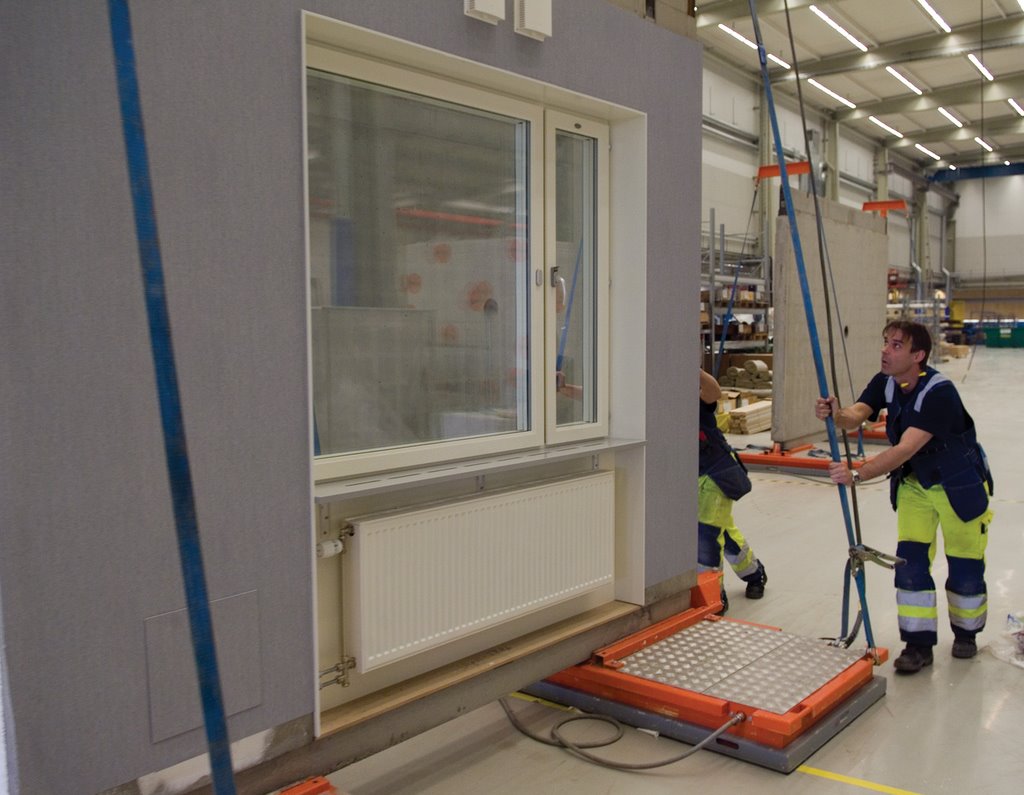
Swedish contractor NCC has created a quite revolutionary factory for producing prefab houses. Usually 90% of construction is done at the building site. With this concept, 90% of construction is done in the controlled and automated factory environment. The assembly on site is done underneath a giant tent, so no water damage etc.
NCC claims that they have cut production time for housing in half.
There's a 7 minute film about the concept at their website.
Dawkin's back
There's a number of podcast out there with excellent speeches and interviews with Richard Dawkins talking about his latest book "The God delusion".
- A twenty minute speech at TED talks
- An hour long interview on point of inquiry
He speeks eloquently on the dangers of blindly accepting religius dogma and explanations based on faith. Very refreshing.
I transcribed this snippet from his recent speech Poptech - which is not online yet:
Science has taught us many things against our intuition. Appearantly solid things like crystals and rocks are almost entirely empty space – the familiar illustration is a fly in the middle of a sports stadium. The nucleus is the fly in the middle of the sports stadium and the next nucleus is the next fly in the middle of the next sports stadium.
The hardest, densest rock is ”really” almost entirely empty space, broken only by tiny particles so widely spaced they shouldn’t count. Why then do rocks feel hard and solid and impenetrable. Well, as an evolutionary biologist I’d say something like this: Our brain has evolved to help us survive within the orders of magnitude of size and speed at which our body normally operates. We never evolved to navigate in the world of atoms – if we had, our brains would probably percieve rocks as full of empty space.
Rocks feel hard and impenetrable to our hands because our hands themselves can’t penetrate them. It’s therefore useful to our brians to construct notions like solidity and impenetrability.
Moving to the other end of the scale, our ancestors never had to move through the cosmos at anything like the speed of light, if they had our brains would be much better equipped to deal with Einsteins ideas of relativity.
I give the name middleworld to the medium scale environment, the things moving at medium speeds , in which we have evolved, in which our brains have evolved to understand and take action.
- A twenty minute speech at TED talks
- An hour long interview on point of inquiry
He speeks eloquently on the dangers of blindly accepting religius dogma and explanations based on faith. Very refreshing.
I transcribed this snippet from his recent speech Poptech - which is not online yet:
Science has taught us many things against our intuition. Appearantly solid things like crystals and rocks are almost entirely empty space – the familiar illustration is a fly in the middle of a sports stadium. The nucleus is the fly in the middle of the sports stadium and the next nucleus is the next fly in the middle of the next sports stadium.
The hardest, densest rock is ”really” almost entirely empty space, broken only by tiny particles so widely spaced they shouldn’t count. Why then do rocks feel hard and solid and impenetrable. Well, as an evolutionary biologist I’d say something like this: Our brain has evolved to help us survive within the orders of magnitude of size and speed at which our body normally operates. We never evolved to navigate in the world of atoms – if we had, our brains would probably percieve rocks as full of empty space.
Rocks feel hard and impenetrable to our hands because our hands themselves can’t penetrate them. It’s therefore useful to our brians to construct notions like solidity and impenetrability.
Moving to the other end of the scale, our ancestors never had to move through the cosmos at anything like the speed of light, if they had our brains would be much better equipped to deal with Einsteins ideas of relativity.
I give the name middleworld to the medium scale environment, the things moving at medium speeds , in which we have evolved, in which our brains have evolved to understand and take action.
Friday, October 27, 2006
A long wait for a good beer - Guinness evolution ad
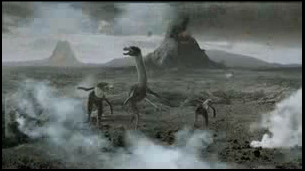
Just saw this amazing ad for Guinness, three guys in a pub that suddenly get thrown backward in evolution, 3 billion years to the point where they lizards drinking foul water at some pond. Sometimes ads are so great.
Monday, October 23, 2006
The singularity summit as podcasts
So much good stuff, so little time.
There’s a number of very good talks available as podcasts from the Singularity Summit at Stanford – back in may.
A little snippet: In his speech Cory Doctorow has a good description of the fundamental problem with controlling the network with heavy-handed Digital rights management:
All complex systems have parasites and you can’t solve parasites by rendering the system simple. Solving the parasites by rendering the system simple renders the system not powerful enough to not even bother with.
There’s a number of very good talks available as podcasts from the Singularity Summit at Stanford – back in may.
A little snippet: In his speech Cory Doctorow has a good description of the fundamental problem with controlling the network with heavy-handed Digital rights management:
All complex systems have parasites and you can’t solve parasites by rendering the system simple. Solving the parasites by rendering the system simple renders the system not powerful enough to not even bother with.
Mega cities on display in Venice
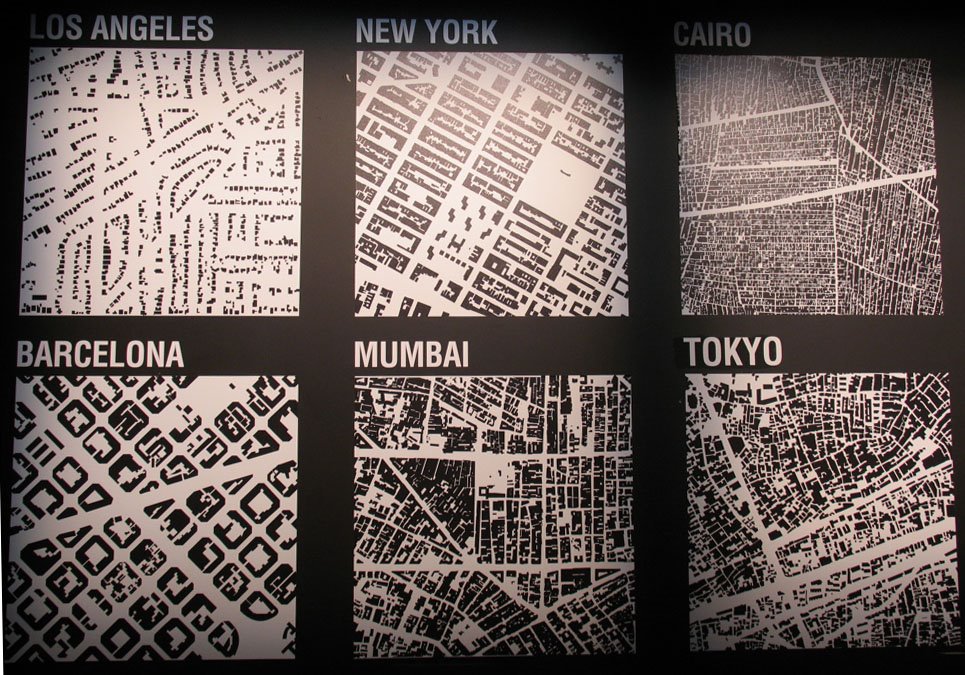
The biennale on architecture in Venice is well worth a visit – you should reserve two days for it, there’s a lot to see. It’s hard work, but luckily there’s all of that wonderful Italian coffee to pick you up.
It closes on november 18th.
The theme this time is Mega cities, and the main exhibition looks at 16 major cities: Caracas, Cairo, Mexico City, Cairo, Berlin, Shanghai, Istanbul and Los Angeles are among them.
Lots of good analysis, breathtaking multimedia, amazing photos and interesting facts. Such as:
There’s one square meter of free space pr. Inhabitant in Cairo.
In 2050 8 billion people will be living in cities - 3/4 of the worlds population, as opposed to just over half today.
The worlds largest city currently is the greater Tokyo metropolitan area with 34 mio. Inhabitants. By 2050 Mumbai is expected to be the largest. It’s currently 18 mio. But will likely be over 40 mio. Then.
In Los Angeles 80% of all transportation is in cars, In Tokyo 80% of transportation uses trains and buses.
The typical daily commuting time in Sao Paolo, Brasil is 4-5 hours.
Half of all cement in the world is used in China. Shanghai alone added 2700 skyscrapers in the past ten years, increasing the number of hi-rises tenfold.
60% of Mexico Cities inhabitants are squatters. The rates for ”informal” occupancy is similar in many third mega-cities.
The impression I got away with was that of to very strong, opposing forces, top-down and bottom-up. One is city planning and architecture on an absolutely massive, soviet style scale. The exhibition shows any number of very large projects for brand new cities with hundreds of thousands of inhabitants – particularly for Asia.
The other force is the flood of poor people simply moving to the city, putting up their shacks where it’s possible. Seen from above, it looks like a sea of corrugated tin roofs and muddy roads swallowing the old, official cities.
The Venezuelan pavilion is about the slums of Caracas. On a wall-size sign it’s states something like: These people have no use for architects. This sort of city does not look like someone intended. But perhaps, the solutions that the people in the slums find to solve the extreme pressure on resources could be used by all of us.
For old times sake I did a radio-report for Radio Denmarks Orientering.
It’s in Danish, though. You can hear it here.
Sunday, October 22, 2006
Craig Venter at Poptech

I missed Poptech this year, but very generously the amazing Poptech team streamed the whole conference - so I’ve kinda been there, at least virtually.
The one talk I was really looking forward to was Craig Venter – of decoding the human genome fame. He came on as the last speaker. He’s almost scary in his laser like determination and belief in what he’s doing, but I get this feeling that we’d better listen. He’s working on “synthetic biology”, his project is to create new life from the bottom up, bacteria which can be tailored to do Really Usefull Stuff – like eating CO2 and turning it into energy for us to use.
It’s a wonderful prospect, but I can see a million things going wrong before we can relax about large scale use of synthetic bacteria.
The following passage of Venter’s speech gets into some of the details. Sounds to me like he’s spelling out the future - although I’m not sure that I’ve gotten all the spelling right:
No cells’ genome has yet been even remotely synthesized and even genome replacement has not yet been demonstrated. So we’re early on, but we think there’s tremendous use for this key technology as we go forward.
This audience clearly knows about energy demand and the potential to develop new fuels. My view is coming a little bit from a different side in terms of what we are doing to the environment; We’re adding 3,5 billion tons of CO2 to the atmosphere each year, we can not afford to ignore any technology that offers a solution.
We’ve designed, on paper, organisms that can take that CO2 back from the atmosphere and fix the CO2 into cellular proteins, sugars, biopolymers etc. Just recently Dupont has opened a plant in Tennessee that has silos, 4 of them, about the size of this room, for producing propanediol from sugar, that goes into their new ceronapolymer that’s going to be used for stain free carpets and clothing - all derived from modifying the genome of a bacteria. They are starting with sugar, but we can go back further, to CO2.
We have metabolic pathways that can take carbon monoxide out of the air, split water with that, producing hydrogen and oxygen. We can go from methane to produce hydrogen or other fuels. We have a team working on modifying photosynthesis to go straight from sunlight into hydrogen production without any other energy being added - and we and others have been working on modifying cells to produce burnable fuels directly.
So cellulasis, or enzymes that break down the complex sugars that form plants and trees – everybody knows that termites can eat wood but in fact termites can not eat wood, they have bacteria in their guts, the cellulasis, that break down the cellulose into simple sugars.
The goal is to convert some of agriculture where we can capture back some of this carbon in a recyclable fashion. People are starting with ethanol but there is no reason why in a few years time we can’t go right from cellulose through a bacteria to make butane, propane, even octane directly.
Now all of a sudden, in stead of taking carbon from the ground, burning it and putting it in the atmosphere we can recycle it through the process of photosynthesis. We’re looking at a wide variety of plants as feed stocks, going into producing chemicals as Dupont is doing, for nutraceuticals and most importantly into energy - in terms of what we are rapidly doing to this planet.
I’m the least worried about disease, whether it’s manmade or new emerging infections affecting humanity. In the long term. if we destroy our spaceship, which we are in the process of doing, disease will not matter.
Subscribe to:
Posts (Atom)