A few postings ago I ranted about how what's considered "technology" varies between the developed and the developing world. Another observation about that:
Recently at Danfoss universe we had professor Neil Gershenfeld from MIT's Center for Bits and Atoms visit us and talk about his "fablab" concept.
His observation was that in developed countries, the fablabs would be used by people who created stuff they need: spare parts, some sort of sensor, a better machine for their work - practical things for daily survival.
At the fablab in Boston and at his classes at MIT, the lab would be used for self expression; art projects, weird non-rational ideas.
To me, the important part is that it's all very creative and no matter if you are creating to survive or creating to fight boredom, you need to get some basic understanding of the tools and the principles of constructing things in order to make an idea physical.
But it underlines the differences in how we approach technology in different parts of the world.
Tuesday, September 20, 2005

Big green
So GE is going green - or, at least they're making a big splash with their new Ecomagination theme..
In a way I would love to think that they are serious about their commitment, I really hope that they have realized that they can play a decisive role in changing the course away from destruction. But then again, it's hard not to be a bit cynical about corporate greeenwash.
There are some weird, but no doubt carefully calculated, touches to their website. It shows CEO Immelt and others talking to us, set in an abstract landscape held in earthly green and brown colors. There are trees, birds, water - and then an airplane crosses the sky in the background. I guess it's meant to show that planes are as natural as birds.
Another part of the flash animation shows a big cruise ship making it's way in the background. GE assures us: planes and cruise ships will not go away, even if we try to save the planet.
GE presents some amazing statistics and predictions, quoting the UN:
Registered autos in 1990: 560 mio.
- in 2010: 940 mio.
Oil consumption in 1990: 24 bio. barrels
- in 2010: 38 bio. barrels
Soft drink consumption in 1990: 364 mio. barrels
- in 2010: 765 mio. barrels
Municipal waste in 1990: 420 mio. tons
- in 2010: 860 mio. tons
In a way I would love to think that they are serious about their commitment, I really hope that they have realized that they can play a decisive role in changing the course away from destruction. But then again, it's hard not to be a bit cynical about corporate greeenwash.
There are some weird, but no doubt carefully calculated, touches to their website. It shows CEO Immelt and others talking to us, set in an abstract landscape held in earthly green and brown colors. There are trees, birds, water - and then an airplane crosses the sky in the background. I guess it's meant to show that planes are as natural as birds.
Another part of the flash animation shows a big cruise ship making it's way in the background. GE assures us: planes and cruise ships will not go away, even if we try to save the planet.
GE presents some amazing statistics and predictions, quoting the UN:
Registered autos in 1990: 560 mio.
- in 2010: 940 mio.
Oil consumption in 1990: 24 bio. barrels
- in 2010: 38 bio. barrels
Soft drink consumption in 1990: 364 mio. barrels
- in 2010: 765 mio. barrels
Municipal waste in 1990: 420 mio. tons
- in 2010: 860 mio. tons
Monday, September 19, 2005
So you think you can tell
 An amazing quote from Shell's scenario planning division in their 2001 scenarios "energy need, choices and possibilites 2050":
”Technology improvements are likely to outpace rising depletion costs for at least the next decade, keeping new supplies below $20 per barrel.
The costs of biofuels and gas to liquids should both fall well below $20 per barrel of oil equivalent over the next two decades, constraining oil prices”.
...This is the worlds' largest oil company and its very well qualified scenario division speaking.
Wednesday, September 14, 2005
Wrecking the world for trinkets

There’s a certain genre of products that I vigorously hate. The stuff you buy in gift shops, or in the kind of surplus stores where every item in the store costs a euro or two. Cheap toys, cheap tools, decorations, colorful blinking gadgets.
At every birthday you end up with a heap of these items. Trinkets, little curiosities, jokes. A pen radio, a weird looking plastic sculpture, a set of screw drivers...
My problem with it is that in one sense these things are not cheap at all. There’s a price. You get a clear sense that behind each of them, there’s some horror story of dreadful working conditions, toxic materials, and poor people slaving at miserable salaries.
How else can you make money on transporting an item all the way here – where somebody still is able to make money on it, though it only costs a couple of euros.
Another reason I get upset is this whole idea of producing stuff so cheaply that it doesn’t really ever work. Tools that are so imprecise and cast from soft iron so soft you can’t do anything with them. Toys that only work for a few minutes, ”funny” figures of plastic that are fun for a moment – and then gather dust. What are we teaching our kids by giving them this crap?
Items made of finite or toxic materials, wrapped in even more materials, shipped across the globe, giftwrapped – all this, just to proceed straight to the junkheap.
I get the feeling that we are wrecking the world for trinkets.
Outlook - the game
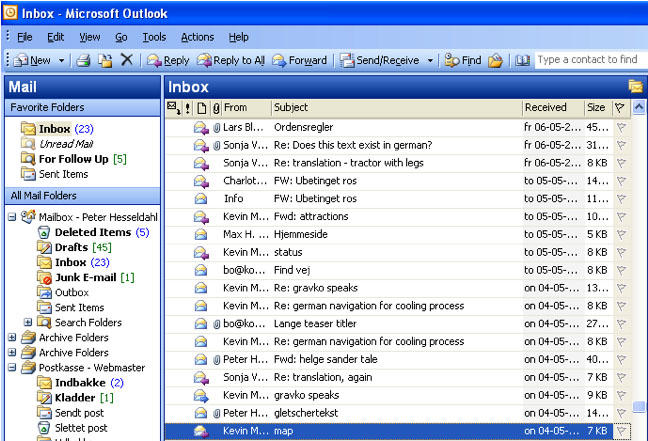
On several occasions lately, I’ve been trying to explain why MMOGs (yes, Massively Multiplayer Online Games) are interesting to study as an indicator of how we will cooperate, socialize, trade, create and seek information in the years ahead.
The hard part part is the ”game” word. Games, and computer games in particular, carry a lot of stigma. Many see it as exactly the opposite of the kind of interaction and participation they would like to see.
It seems to help if you describe the ubiquitous Microsoft Outlook as an MMOG. We don’t think of it as playing a game, but we do spend hours in that environment, dealing with lots of players, some of whom we build up quite close relationships to online. Like an MMOG, Outlook is something you build up, it’s persistent and dynamic, even if you’re not yourself online. There’s considerable creative possibilities, you can trade, exchange information or products, you can co-create, you can have pranks and challenges.
But of course, there’s not much in terms of graphics, no avatars, no soundtrack – yet...
Saturday, September 10, 2005
Jetplanes and guilt
No doubt that airplanes consume lots of fossil fuel and generally mess up the atmosphere in a major way. Nevertheless, travelling is hard to avoid if you wanna get anywhere.
My good friend Adam has heard my scruples about flying for years. He pointed me to this article from OnEarth Magazine which tells about a number of organisations that will plant trees for you to offset the effects of your flying.
For instance, a round trip from San Francisco to Shanghai will produce 2.2 tons of carbondioxid emissions. This can (in some more or less abstract sense) be offset by planting three trees or changing three ordinary light bulbs to energy saving ones. Depending on what organisation you choose, for around $20-40 you can have them plant the trees or install lightbulbs.
Among the organisations are American Forests, which have an online Climate calculator that will give you a sobering view at the side effects of transportation.
My good friend Adam has heard my scruples about flying for years. He pointed me to this article from OnEarth Magazine which tells about a number of organisations that will plant trees for you to offset the effects of your flying.
For instance, a round trip from San Francisco to Shanghai will produce 2.2 tons of carbondioxid emissions. This can (in some more or less abstract sense) be offset by planting three trees or changing three ordinary light bulbs to energy saving ones. Depending on what organisation you choose, for around $20-40 you can have them plant the trees or install lightbulbs.
Among the organisations are American Forests, which have an online Climate calculator that will give you a sobering view at the side effects of transportation.
Tuesday, September 06, 2005

What's the right question?
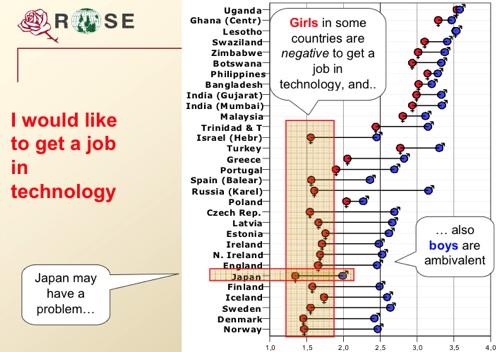
There’s plenty of concern about the lack of interest and knowledge about technology and natural science among children and students. However, it’s a little hard for me to see exactly where the problem lies. For instance, The ROSE study, which has asked a huge number of children all over the world about their interests in science, clearly shows that children in the richest countries have the least interest and respect for science.
A particularly telling statistic is this figure, which I have taken from a presentation by Norwegian professor Svein Sjöberg who leads the Rose study.
Kids were asked if they would like to get a job in technology. This is very appealing to kids in countries like Lesotho, Uganda or Zimbabwe, whereas kids are increasingly negative the richer the country the come from is. The least interested in a technology job are Japanese boys.
Other questions in the study show pretty much the same attitude to science and technology.
Now, does this mean that Japanese boys don’t care about technology? I doubt it. It’s hard to think of anyone who are more inundated by technology than japanese boys. They live in a world that is nothing but technology, and mastering technology determines how well they can participate socially in society.
Technology in Osaka is not the same as in Kampala. The japanese boy may not be interested in basic technology, because it is not relevant and immediately necessary for him to know about it in the same way that it is for someone in Uganda.
You miss something very important if you don’t realize that the japanese boy is very likely to have an expert knowledge in technologies like sharing files, surfing and downloading, choosing the right shoe for athletics or the set of headphones with just the right sound. But it could very well be that this is not ”technology” to him – it’s just the way the world works.
Maybe we need to ask the question in a different way in order to understand what relation students have to science. I bet it would turn out to be a lot more sophisticated than current studies show.
Wednesday, June 22, 2005
No, you're too fat to drive
My daughter (14 years) was talking about how she would like to have a moped or a car so she could just drive around effortlessly. We then talked about how fat she would get if she didn’t get to walk and bike.
Her solution: a moped, or Segway of sorts, that would measure your body fat index and refuse to drive if you were getting too heavy.
I could see some interesting scenes with people trying to argue with their Segway or hacking it to give ’em a ride.
Her solution: a moped, or Segway of sorts, that would measure your body fat index and refuse to drive if you were getting too heavy.
I could see some interesting scenes with people trying to argue with their Segway or hacking it to give ’em a ride.
Gentlemen, start you engines

5xgrill
Originally uploaded by Peter Hesseldahl.
It's time to get out the grill before winter strikes again.
A public private sphere
The computer screen is an interesting mix of a public and a very private space. You know the situation: Someone is showing you something on their computer or you are doing a search together, and inevitably all sorts of little private bits come up. The browser shows what other URLs have been visited, The bookmark bar gives an idea of where the person usually goes to hunt information, Google reveals what other searches have been done.
The latest version of Apples Safari browser (2.0) has a feature called ”private browsing”. This is how Apple describes it:
”When private browsing is turned on, webpages are not added to the history, items are automatically removed from the Downloads window, information isn't saved for AutoFill (including names and passwords), and searches are not added to the pop-up menu in the Google search box”.
I like that, It really annoyed me that I couldn’t control what information I revealed about myself to anyone who I might be collaborating over the screen with.
But in fact, it’s more or less just returning to how things used to be. It would seem smarter if you could opt for an in-between solution. Keeping the data, but only showing them if you specifically need to. History data can be very usefull – and very revealing.
One more thing, sort of on the same subject: I hate it when powerpoint presentations end, or when you have to skip from one presentation to the next, and the whole crowd gets exposed to the desktop clutter. It’s like seeing people in their underwear, it can be interesting, a voyeuristic thrill, but basically it damages concentration on the topic you were supposed to focus on.
The latest version of Apples Safari browser (2.0) has a feature called ”private browsing”. This is how Apple describes it:
”When private browsing is turned on, webpages are not added to the history, items are automatically removed from the Downloads window, information isn't saved for AutoFill (including names and passwords), and searches are not added to the pop-up menu in the Google search box”.
I like that, It really annoyed me that I couldn’t control what information I revealed about myself to anyone who I might be collaborating over the screen with.
But in fact, it’s more or less just returning to how things used to be. It would seem smarter if you could opt for an in-between solution. Keeping the data, but only showing them if you specifically need to. History data can be very usefull – and very revealing.
One more thing, sort of on the same subject: I hate it when powerpoint presentations end, or when you have to skip from one presentation to the next, and the whole crowd gets exposed to the desktop clutter. It’s like seeing people in their underwear, it can be interesting, a voyeuristic thrill, but basically it damages concentration on the topic you were supposed to focus on.
Thursday, June 09, 2005
Phone booth without a phone

finnish_phone_booth_crop_500
Originally uploaded by Peter Hesseldahl.
Nice touch. Where else but in Finland would you find a phone booth in trains without a phone? Or rather: In Finland, why would you want a phone in a booth for phoning - everyone has a phone in their pocket already.
Somehow significant; the way technology changes the architecture of the space we inhabit.
Friday, June 03, 2005
Bad energy forecast
Once again I walk away from a conference rather disturbed by what I’ve heard, but still professionally conscious that there are so many other schocking facts that we never really have the time to deal with.
Once again, an hour long barrage of powerpoints with curves all pointing in the wrong direction. You sit there, hoping for one of the speakers to finally pull out a solution. But no.
In this case an international conference on future energy consumption and supply at the national Danish research center Risø.
One speaker, Fatih Birol from IEA, the International Energy Agency, laid out the forecast with considerable institutional authority.
Among the conclusions of the IEA:
- Global energy cosumption will rise 60 % until 2030
- Almost all of the growth will be in the developing world
- There will be NO decoupling of energy use and carbon dioxide emmisions (in other words, the climate is screwed)
- As the oil wells of the EU and US run dry, a dramatically increasing share of the worlds energy will be supplied be a handfull of rather instabil countries, notably Saudi, Russia, Iran, Irag, and Nigeria.
Once again, an hour long barrage of powerpoints with curves all pointing in the wrong direction. You sit there, hoping for one of the speakers to finally pull out a solution. But no.
In this case an international conference on future energy consumption and supply at the national Danish research center Risø.
One speaker, Fatih Birol from IEA, the International Energy Agency, laid out the forecast with considerable institutional authority.
Among the conclusions of the IEA:
- Global energy cosumption will rise 60 % until 2030
- Almost all of the growth will be in the developing world
- There will be NO decoupling of energy use and carbon dioxide emmisions (in other words, the climate is screwed)
- As the oil wells of the EU and US run dry, a dramatically increasing share of the worlds energy will be supplied be a handfull of rather instabil countries, notably Saudi, Russia, Iran, Irag, and Nigeria.
Wednesday, June 01, 2005
Where am I?

IMG_7565_crop_500
Originally uploaded by Peter Hesseldahl.
Just a striking scene. A Danish-Japanese festival at Egeskov slot, one of the arch-typical historical castles. So here’s a women in Kimono who’s travelled from Japan to watch Danish kids playing traditional Japanese music. I realize that this mix of culture probably wouldn’t even be noticed in so many other places. In Denmark this is still a budding future.
A new kind of roadkill
Weird thought: Driving through the countryside you see the warning signs of deer and other wildlife crossing – and certainly on the roads there’s a variety of flattened animals on display.
When will they start putting up signs on the roads in metropolitan areas warning against stray robots, hurtling themselves more or less mindlessly into the traffic?
When will they start putting up signs on the roads in metropolitan areas warning against stray robots, hurtling themselves more or less mindlessly into the traffic?
Communism 2.0.
I could see it happening at some point. So many of the technologies that we believe – on balance – promote freedom rather than control, could be turned against us as individuals, presumably for the sake of the greater common good.
Our world is becoming transparent, on record, searchable. Typically what we we’re getting is greater freedom, but greater responsibility and accountability, too. At the moment we don’t really have to think too much about the responsibility part – not in a fundamental sense, like in terms of water, energy or food.
Rather often, though, when you look ahead, the prognosis looks like major crunch. Getting through a period of true crisis could change the technological balance dramatically. If things get tight, it would seem very easy to slip in the directions of a lot more control and disciplin. Not necessarily enforced from above as such, rather a general feeling that everyone should pitch in, that we can’t tolerate hogging ressources or behaving in a blatantly anti-social way. Central planning and common standards could be enforced like never before. Hitting the wall in terms of ressources we would face an installed instrument of pervasive control. It might even work – but I’d rather that we find ways to maintain some slack in time.
Our world is becoming transparent, on record, searchable. Typically what we we’re getting is greater freedom, but greater responsibility and accountability, too. At the moment we don’t really have to think too much about the responsibility part – not in a fundamental sense, like in terms of water, energy or food.
Rather often, though, when you look ahead, the prognosis looks like major crunch. Getting through a period of true crisis could change the technological balance dramatically. If things get tight, it would seem very easy to slip in the directions of a lot more control and disciplin. Not necessarily enforced from above as such, rather a general feeling that everyone should pitch in, that we can’t tolerate hogging ressources or behaving in a blatantly anti-social way. Central planning and common standards could be enforced like never before. Hitting the wall in terms of ressources we would face an installed instrument of pervasive control. It might even work – but I’d rather that we find ways to maintain some slack in time.
Back to the middleman
I may be the last person discovering this, but just in case you haven’t heard: Sending your digital photos off to a real photo printing shop is simply vastly better than using a printer at home. You get that nice glossy and saturated quality that we used to get with film. God knows I’ve tried at home; with the best paper, fresh ink cartridges, maximum rendering quality, but it never really gets near to what sending your photos to a real printing shop can achieve. Find some service, mail you files, pick ’em up a few days later. It’s cheaper too.
Friday, May 06, 2005
Danfoss Universe - open for business!
Yes, finally, we're open. It's been a frantic effort in the past weeks, but everything is pretty much ready and up & running. Yesterdays' grand opening featured The crown princess and princess + other assorted royaltyi and lots of Very VIPs. Having 2500 guests in the park wnt a lot more smoothly than we had expected.
For my part, I've been coordinating the website - here, take a look.
For my part, I've been coordinating the website - here, take a look.
Sunday, May 01, 2005
Climate change: now you see it
I happened to come across this amazing collection of very telling images which show glaciers retreating, snow melting, high tides etc. Climate change at it's most visible.
Tuesday, April 26, 2005
The ancient power of love
I've spent more time than ever in churches in recent months in preparation for our daughter's confirmation last weekend. It's nice - but ergonomically very uncomfortable - to sit there for an hour or so, singing the old psalms, listening to the amazing scriptures, hearing the priest preaching...
I am not babtized. I don't really feel a member, there's so much about the institution of the church that I have a hard time with. (E.g.the insistence on one, well defined God, the tendency to use God's forgiveness as an excuse for independent thinking and responsibility...)
Never the less, you cannot but marvel at the wisdom of the words of Paul in the first corinthian letter:
If I speak in the tongues of men and of angels, but have not love, I am only a resounding gong or a clanging cymbal. If I have the gift of prophecy and can fathom all mysteries and all knowledge, and if I have a faith that can move mountains, but have not love, I am nothing. If I give all I possess to the poor and surrender my body to the flames, but have not love, I gain nothing.
Love is patient, love is kind. It does not envy, it does not boast, it is not proud. It is not rude, it is not selfseeking, it is not easily angered, it keeps no record of wrongs. Love does not delight in evil but rejoices with the truth. It always protects, always trusts, always hopes, always perseveres.
Love never fails. But where there are prophecies, they will cease; where there are tongues, they will be stilled; where there is knowledge, it will pass away. For we know in part and we prophesy in part, but when perfection comes, the imperfect disappears. When I was a child, I talked like a child, I thought like a child, I reasoned like a child. When I became a man, I put childish ways behind me. Now we see but a poor reflection as in a mirror; then we shall see face to face. Now I know in part; then I shall know fully, even as I am fully known.
And now these three remain: faith, hope and love. But the greatest of these is love.
I am not babtized. I don't really feel a member, there's so much about the institution of the church that I have a hard time with. (E.g.the insistence on one, well defined God, the tendency to use God's forgiveness as an excuse for independent thinking and responsibility...)
Never the less, you cannot but marvel at the wisdom of the words of Paul in the first corinthian letter:
If I speak in the tongues of men and of angels, but have not love, I am only a resounding gong or a clanging cymbal. If I have the gift of prophecy and can fathom all mysteries and all knowledge, and if I have a faith that can move mountains, but have not love, I am nothing. If I give all I possess to the poor and surrender my body to the flames, but have not love, I gain nothing.
Love is patient, love is kind. It does not envy, it does not boast, it is not proud. It is not rude, it is not selfseeking, it is not easily angered, it keeps no record of wrongs. Love does not delight in evil but rejoices with the truth. It always protects, always trusts, always hopes, always perseveres.
Love never fails. But where there are prophecies, they will cease; where there are tongues, they will be stilled; where there is knowledge, it will pass away. For we know in part and we prophesy in part, but when perfection comes, the imperfect disappears. When I was a child, I talked like a child, I thought like a child, I reasoned like a child. When I became a man, I put childish ways behind me. Now we see but a poor reflection as in a mirror; then we shall see face to face. Now I know in part; then I shall know fully, even as I am fully known.
And now these three remain: faith, hope and love. But the greatest of these is love.
Subscribe to:
Comments (Atom)