This fake advertising for Volkswagen Polo is utterly distasteful, I know.
Wednesday, November 23, 2005
Bad taste - but funny, somehow

Sunday, November 20, 2005
Friday, November 18, 2005
The place to sleep in Copenhagen
I have previously blogged about how much I like staying at hotel Guldsmeden in Århus. They have a hotel in Copenhagen as well and I can now report that it is just as great. Good atmosphere, nice furniture, free wifi, best breakfeast I can remember offhand. Reasonable prices too.
Appearantly the Guldsmeden folks are going upscale next. They are renovating another Copenhagen hotel, it will be a 4 star joint, with a cafe. If I get the chance to stay there, I shall report.
Olafur Eliassons "Light Setup"

If you are anywhere near the Swedish cities Malmø or Lund I can recommend taking a look at Olafur Eliassons twin exhibitions at the municipal art spaces of those two cities. The title is ”the light setup”.

The show in Lund is a collection of around hundred works, more or less finished, each an experiment testing some idea, an effect, a shape, an optical illusion. At first it looks it looks pretty messy, like a peek into someone’s workshop, but once you get into it, great depths of beauty reveal themselves.

The way I see it, Eliasson doesn’t really create art himself. Rather, he creates mechanisms and spaces where we can stop and discover the art and beauty in natures’ shapes and functions. Waves, spiral, shadows, fractals. Very stimulating.
The other show is very different. All of Malmø kunsthal is just one great space. At one end the whole is turned into a bright, uniform light, with the warmth of the color oscillating slightly from yellowish to more blue. Part of the ceiling is also a big sheet of light. Simple, beautiful. Go see!
Open til january 8th.

Tuesday, November 08, 2005
Clashing paradigms - work in progress
So, I've tried to list the characteristics of these two paradigms that seem to be clashing and changing in strength relative to eachother, un-easily overlapping and co-existing.
I'd be happy to hear any comments or additions.
Sorry about the layout, I can't figure out how to fix it. Just keep scrolling down, it will come.
I'd be happy to hear any comments or additions.
Sorry about the layout, I can't figure out how to fix it. Just keep scrolling down, it will come.
| industrial society | information society |
| Hierarchical | networked |
| top down | bottom up |
| client - server | p2p |
| zero sum | plus sum |
| screw 'em | explicit interdependence |
| exclusivity | sharing, open source |
| distinct roles, producer - consumer | blurring roles, co-creation |
| Monopolization of means of production | Distribution of the means of production |
| high entry barrier to production | low entry barrier |
| Broadcast | many to many |
| centralisation | decentralisation |
| Authority | wisdom of the crowd |
| Follow orders | creative thinking |
| motivation; money, orders | motivation: fun, recognition |
| control | anarchy (as Kropotkin defined it) |
| vision, direction, intent | emergent solution |
| Radically different innovation | incremental innovation |
| Longterm planning | Ad hoc |
| mechanical paradigm | biological |
| exact | fuzzy |
| hard science, predictable | soft science, probabilistic |
| reductionist | holistic, emergence |
Flying in the face of reason
Weird, this shouldn’t happen. One of the largest adjustments in the national budget that the government just announced is removing the taxes on airplane trafik, which currently is about 10 euro pr. Flight.
In the news, this was presented as something like a christmas gift to us all; Ah, now we can go fly as we please, unburdened by crunching taxation.
But this is 2005, we’re in the age of rampant global climate change and the end of fossil fuel is near. If anything, I would have expected an attempt to finally put some taxes on jet fuel which at the moment is totally exempt.
We’ve got a fundamental clash of logics happening here:
The prevailing logic: Gotta move faster. Of course, cause everybody else does, too. I understand, I really do.
The logic of reality as I see it to the best of my knowledge:
Air traffic is the fastest growing segment in transportation. Travelling a mile in a plane uses about the same amount of fuel pr. Person as in with cars – but you rarely just get in and fly 1000 km. or more for a meeting or a weekend. Plus, the fumes are released in a more fragile part of the atmosphere making their contribution to the greenhouse effect much worse. Compared to car travel, air traffic is way cheaper because there are no taxes on the fuel.
Meanwhile, DSB – the national Danish railways – are losing thousands of passengers due to perpetual, yet un-predictable major delays because the trains can no longer drive at high speeds on rails that are poorly maintained.
In the news, this was presented as something like a christmas gift to us all; Ah, now we can go fly as we please, unburdened by crunching taxation.
But this is 2005, we’re in the age of rampant global climate change and the end of fossil fuel is near. If anything, I would have expected an attempt to finally put some taxes on jet fuel which at the moment is totally exempt.
We’ve got a fundamental clash of logics happening here:
The prevailing logic: Gotta move faster. Of course, cause everybody else does, too. I understand, I really do.
The logic of reality as I see it to the best of my knowledge:
Air traffic is the fastest growing segment in transportation. Travelling a mile in a plane uses about the same amount of fuel pr. Person as in with cars – but you rarely just get in and fly 1000 km. or more for a meeting or a weekend. Plus, the fumes are released in a more fragile part of the atmosphere making their contribution to the greenhouse effect much worse. Compared to car travel, air traffic is way cheaper because there are no taxes on the fuel.
Meanwhile, DSB – the national Danish railways – are losing thousands of passengers due to perpetual, yet un-predictable major delays because the trains can no longer drive at high speeds on rails that are poorly maintained.
Saturday, November 05, 2005
Good reasons not to act
Looking at the various curves stretching upwards forecasting the rising consumption of natural ressources - the number of people on earth, the concentration of CO2 in the atmosphere, the rising sea level and increasing temperature - it is pretty obvious that we are in for some fundamental changes in the coming decades.The main question seems to be whether it will be a relatively smooth transition or one of collapses and disruptions.
We ought to change our lifestyle and our consumption – but we don’t. To the contrary, it’s an age of expansion, for many of us way beyond what we were able to imagine just recently.
There are good reasons NOT to hold back on consumption. Maybe the most important one is that consumption of ressources is directly related to power. The more energy you use, the more power you have – more or less. If you jet around, if you jump in the car and speed ahead, if you don’t slow down to pick up the garbage, you will have more power. You can get things done, you are a player in a very different way than somebody ”sitting self- righteously at home in a woolen sweater”, as British journalist Mark Lynas puts it.
Changing the world by setting a good example of low consumption and responsible behaviour sounds like the right path, but it’s just not very sexy.
And maybe, maybe it’s simply not the best solution.
Who knows? Maybe the best we can do is to keep jetting around, accellerating life and the economy in the hope that this will quicken the development of some wonderful technical fix that will once again buy us time in the land of mindless, convenient consumption.
It’s weird, though, there’s so much we ought to do, so many solutions that we pretty know would help somewhat, but ironically we’re simply too busy to do anything serious about it.
Engaging ourselves in changing the world will be a very sophisticated sell – or it will be prompted by un-ignorable necessity.
We ought to change our lifestyle and our consumption – but we don’t. To the contrary, it’s an age of expansion, for many of us way beyond what we were able to imagine just recently.
There are good reasons NOT to hold back on consumption. Maybe the most important one is that consumption of ressources is directly related to power. The more energy you use, the more power you have – more or less. If you jet around, if you jump in the car and speed ahead, if you don’t slow down to pick up the garbage, you will have more power. You can get things done, you are a player in a very different way than somebody ”sitting self- righteously at home in a woolen sweater”, as British journalist Mark Lynas puts it.
Changing the world by setting a good example of low consumption and responsible behaviour sounds like the right path, but it’s just not very sexy.
And maybe, maybe it’s simply not the best solution.
Who knows? Maybe the best we can do is to keep jetting around, accellerating life and the economy in the hope that this will quicken the development of some wonderful technical fix that will once again buy us time in the land of mindless, convenient consumption.
It’s weird, though, there’s so much we ought to do, so many solutions that we pretty know would help somewhat, but ironically we’re simply too busy to do anything serious about it.
Engaging ourselves in changing the world will be a very sophisticated sell – or it will be prompted by un-ignorable necessity.
Saturday, October 29, 2005
I wish there was some good news
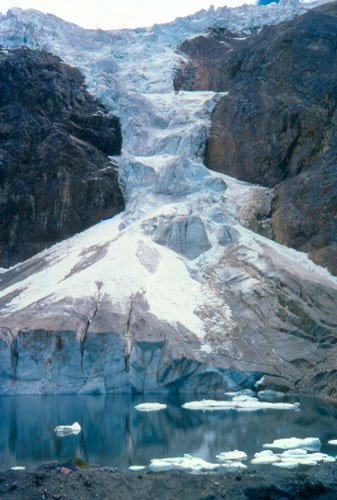
Photos by Mark Lynas, www.marklynas.org
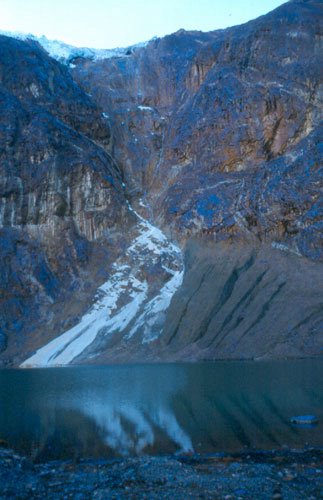
At the Poptech conference last week British journalist Mark Lynas gave one of those presentations that leave you rather depressed.
Global warming is certainly happening, and I keep hoping someone would come up with a bit of good news, like, they've found out that it's not so bad after all. But every time I listen it seems to be getting worse.
Mark Lynas has travelled the globe, documenting the already visible effects of the changing climate. Among other places he went to the Peruvian Andes where his father had worked as a geologist in the 1980ies. He had his dads' old photos from the glaciers there and took new photos in the exact same spots. The upper photo is from 1980, the lower from 2004. Uhh!
A big beautiful whale blowing

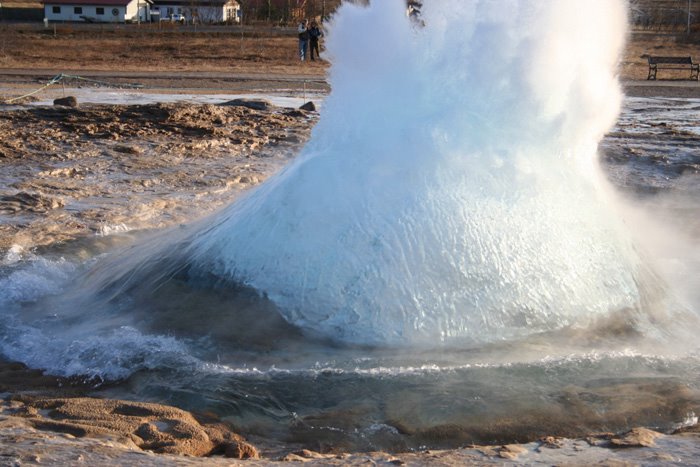
Wonderful, I went to Iceland on business. In the science-park we have an artificial Geysir that erupts 18 meters into the air.
I figured it might be fun to have a live webcam showing the REAL geysir next to ours, as part of our attempts to explain visitors how a geysir works.
So on my way back from Boston I made a stopover and had a great day with my counterpart at the Geysir. Oh Iceland, it’s incredibly beatiful.
The shots here show part of what’s going on; hot and cold meeting in the 40 meter deep hole, pressure building up till suddenly... BOOM!
Then the boiling waters flows back into the hole with a deep sucking sound. You clearly get the sense that the earth is a big, living creature. Rumbling and pumping like a heart beating, drawing air, exhaling, steaming and sweating. Maybe we’re standing on top of a big whale.
Maybe it’s whales all the way down...
Friday, October 28, 2005
Fremtids arkæologi
Sorry, this is just for the Danish speaking:
Jeg har det sidste halve år haft en artikel serie i Samvirke med titlen "fremtids-arkæologi".
Jeg har lagt 6 artikler på mit website, den 7. følger om en måneds tid.
The hands from the trains of Bombay
Suketu Mehta is an indian born journalist who grew up in New York. He went back and spent two and a half years in Bombay – with his wife and two small kids – and he wrote the book ”Maximum city” about this incredible place.
Lots of it seems very depressing, but he offers this beautiful image of why he, despite all the problems, believes that Bombay is a city of the future and how the people living there show a way forward:
”If you are late for work in the morning in Bombay, and you reach the station just as the train is leaving the platform, you can run up to the packed compartments and find many hands stretching out to grab you on board, unfolding outward from the train like petals. As you run alongside the train, you will be picked up and some tiny space will be made for your feet on the edge of the open doorway. The rest is up to you. You will probably have to hang on the door frame with your fingertips, being careful not to lean out too far lest you get decapitated by a pole placed too close to the tracks. But consider what has happened. Your fellow passengers, already packed tighter than cattle are legally allowed to be, their shirts already dreanched in sweat in the badly ventilated compartment , having stood like this for hours, retain an empathy for you, know that you boss might yell at you or cut your pay if you miss this train, and will make space where non exists, to take on more person with them. And at the moment of contact, they do not know if the hand that is reaching for theirs belongs to a Hindu or Muslim or Christian or Brahmin or untouchable or whether you were born in this city or arrived only this morning or whether you live in Malabar Hill or New York or Jogeshwari (...). All they know is that you’re trying to get to the city of gold, and that’s enough. Come on board, they say. We’ll adjust.”
Lots of it seems very depressing, but he offers this beautiful image of why he, despite all the problems, believes that Bombay is a city of the future and how the people living there show a way forward:
”If you are late for work in the morning in Bombay, and you reach the station just as the train is leaving the platform, you can run up to the packed compartments and find many hands stretching out to grab you on board, unfolding outward from the train like petals. As you run alongside the train, you will be picked up and some tiny space will be made for your feet on the edge of the open doorway. The rest is up to you. You will probably have to hang on the door frame with your fingertips, being careful not to lean out too far lest you get decapitated by a pole placed too close to the tracks. But consider what has happened. Your fellow passengers, already packed tighter than cattle are legally allowed to be, their shirts already dreanched in sweat in the badly ventilated compartment , having stood like this for hours, retain an empathy for you, know that you boss might yell at you or cut your pay if you miss this train, and will make space where non exists, to take on more person with them. And at the moment of contact, they do not know if the hand that is reaching for theirs belongs to a Hindu or Muslim or Christian or Brahmin or untouchable or whether you were born in this city or arrived only this morning or whether you live in Malabar Hill or New York or Jogeshwari (...). All they know is that you’re trying to get to the city of gold, and that’s enough. Come on board, they say. We’ll adjust.”
Big box mart - crap ain't free

JibJab have produced another masterpiece. Among many other funny and deep videos they produced the hillarious ”this land” parody about Bush and Kerry using Woody Guthries old song.
Now take a look at the ”Big box mart”- video.
Uhh, very funny, very frightening. Are the chinese taking over – or are we driving ourselves into the ground?
Saturday, October 22, 2005
Marxism and open source
Though he didn’t point it out directly, Yochai Benkler’s talk yesterday at Poptech got me thinking about how the open source paradigm relates to the good old marxist analysis of the power of controlling the means of production.
Marx showed how capitalism tends towards ever larger players as each company has to invest in ever more advanced and more expensive machinery in order to compete.
To finance this increasing investment the companies need to expand their market and this gradually presses out the smaller players who lose out in the escalation of investments.
So, in this way capitalise leads to fewer producers, more expensive means of production and a very clear distinction between those that have the means to produce and the masses that consume.
We see this in places like the production of micro processors, cars, or LCD screens. There’s only room for a handfull of players in these industries – you cannot make chips as a cottage industry.
But then a completely different kind of technology comes along. With PC and networks, suddenly the means of production are in-expensive, they’re in the hands of millions, they are suited for networking, co-laboration.
So the lines between producer and consumer blurrs, and it spreads as more industries see a rising part of what they produce becoming information, digital content.
Obviously, the next step will be when actual physical manufacturing gets into the hands of the masses as 3D printing makes it way into everyday reality.
We’re in the middle of a clash of economic paradigms. In fact the clash extends much further – but that’s a very long story.
From broadcast to conversation/ co-creation

Very interesting new browser coming up, from some of the folks that were involved in firefox. It’s called Flock.
What it seems to do is take another major step towards turning the web into a massively multiplayer conversation.
It makes blogging extremely fast and easy in so far as it speeds up quoting and referring to stuff on other websites. You simply cut and paste what you want to show in your blog. It even automatically insert a link to the original source.
And it has a window for adding tags right at hand.
In fact tagging or marking places of interest and sharing your preferences with others is completely integral to the way you use it – as is RSS feed reading.
For me the significance is the way it from the start treats the web as a place for conversation and remixing. We’re really leaving broadcasting with flock.
Friday, October 21, 2005
The time line is on line

My latest project is a timeline on Danfoss Universe' webpage.
The timeline runs from the year 1700 and by navigating back and forth and clicking on milestones you can learn about the major technological inventions, historical events in world history and in Denmark – and of course, milestones for the Danfoss company. The timeline is launched as part of the celebration of the 100th birthday of Mads Clausen, the founder of the comapany.
It’s been a major effort coordinating a lot of very good people writing, coding, translating, gathering pictures – and IMHO it’s turned quite nice.
For me, the project has yielded a few interesting historical insights: We may feel that we are living in a time when technological development is at ist fastest and most radical ever. But take a look at the fifty years from 1875 to 1925. Among the inventions of that period are:
Telephone
gramophone
moving pictures
Light bulb
battery
AC motor
car
solar cells
time zones
bicycle
x-ray photography
radio
coca cola
airplane
plastic
Relativity theor y
...How’s that for technological change?
MIT press bookstore - ah, the temptations
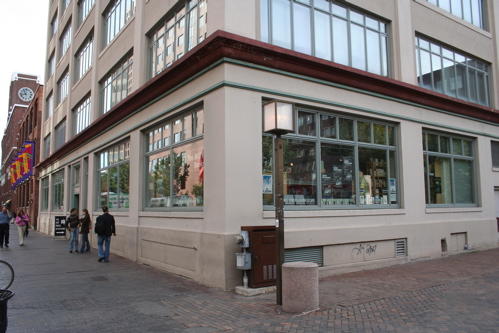
Of all the wonderful bookstores on earth the MIT press bookstore at Kendall square in Cambridge is probably the one I like the best.
Small, compact, packed with way too much interesting information – so much I’d love to know. I can easily spend an hour browsing – and even swing by again the next day.
What I got:
Felice Frankel; Envisioning science
O’reilly’s magazine Make
Vital signs 2005 from Worldwatch institute
Sean Carroll; Endless forms most beautiful – the new science of evo devo
John Thackara: In the bubble
There was much more, I could have gotten. It takes tough discipline and prioritizing. I have to carry it home, and I have to read it. And who knows what other great books I may stumble upon in the coming days?
Tuesday, September 20, 2005
Self expression - or survival
A few postings ago I ranted about how what's considered "technology" varies between the developed and the developing world. Another observation about that:
Recently at Danfoss universe we had professor Neil Gershenfeld from MIT's Center for Bits and Atoms visit us and talk about his "fablab" concept.
His observation was that in developed countries, the fablabs would be used by people who created stuff they need: spare parts, some sort of sensor, a better machine for their work - practical things for daily survival.
At the fablab in Boston and at his classes at MIT, the lab would be used for self expression; art projects, weird non-rational ideas.
To me, the important part is that it's all very creative and no matter if you are creating to survive or creating to fight boredom, you need to get some basic understanding of the tools and the principles of constructing things in order to make an idea physical.
But it underlines the differences in how we approach technology in different parts of the world.
Recently at Danfoss universe we had professor Neil Gershenfeld from MIT's Center for Bits and Atoms visit us and talk about his "fablab" concept.
His observation was that in developed countries, the fablabs would be used by people who created stuff they need: spare parts, some sort of sensor, a better machine for their work - practical things for daily survival.
At the fablab in Boston and at his classes at MIT, the lab would be used for self expression; art projects, weird non-rational ideas.
To me, the important part is that it's all very creative and no matter if you are creating to survive or creating to fight boredom, you need to get some basic understanding of the tools and the principles of constructing things in order to make an idea physical.
But it underlines the differences in how we approach technology in different parts of the world.
Big green
So GE is going green - or, at least they're making a big splash with their new Ecomagination theme..
In a way I would love to think that they are serious about their commitment, I really hope that they have realized that they can play a decisive role in changing the course away from destruction. But then again, it's hard not to be a bit cynical about corporate greeenwash.
There are some weird, but no doubt carefully calculated, touches to their website. It shows CEO Immelt and others talking to us, set in an abstract landscape held in earthly green and brown colors. There are trees, birds, water - and then an airplane crosses the sky in the background. I guess it's meant to show that planes are as natural as birds.
Another part of the flash animation shows a big cruise ship making it's way in the background. GE assures us: planes and cruise ships will not go away, even if we try to save the planet.
GE presents some amazing statistics and predictions, quoting the UN:
Registered autos in 1990: 560 mio.
- in 2010: 940 mio.
Oil consumption in 1990: 24 bio. barrels
- in 2010: 38 bio. barrels
Soft drink consumption in 1990: 364 mio. barrels
- in 2010: 765 mio. barrels
Municipal waste in 1990: 420 mio. tons
- in 2010: 860 mio. tons
In a way I would love to think that they are serious about their commitment, I really hope that they have realized that they can play a decisive role in changing the course away from destruction. But then again, it's hard not to be a bit cynical about corporate greeenwash.
There are some weird, but no doubt carefully calculated, touches to their website. It shows CEO Immelt and others talking to us, set in an abstract landscape held in earthly green and brown colors. There are trees, birds, water - and then an airplane crosses the sky in the background. I guess it's meant to show that planes are as natural as birds.
Another part of the flash animation shows a big cruise ship making it's way in the background. GE assures us: planes and cruise ships will not go away, even if we try to save the planet.
GE presents some amazing statistics and predictions, quoting the UN:
Registered autos in 1990: 560 mio.
- in 2010: 940 mio.
Oil consumption in 1990: 24 bio. barrels
- in 2010: 38 bio. barrels
Soft drink consumption in 1990: 364 mio. barrels
- in 2010: 765 mio. barrels
Municipal waste in 1990: 420 mio. tons
- in 2010: 860 mio. tons
Monday, September 19, 2005
So you think you can tell
 An amazing quote from Shell's scenario planning division in their 2001 scenarios "energy need, choices and possibilites 2050":
”Technology improvements are likely to outpace rising depletion costs for at least the next decade, keeping new supplies below $20 per barrel.
The costs of biofuels and gas to liquids should both fall well below $20 per barrel of oil equivalent over the next two decades, constraining oil prices”.
...This is the worlds' largest oil company and its very well qualified scenario division speaking.
Wednesday, September 14, 2005
Wrecking the world for trinkets

There’s a certain genre of products that I vigorously hate. The stuff you buy in gift shops, or in the kind of surplus stores where every item in the store costs a euro or two. Cheap toys, cheap tools, decorations, colorful blinking gadgets.
At every birthday you end up with a heap of these items. Trinkets, little curiosities, jokes. A pen radio, a weird looking plastic sculpture, a set of screw drivers...
My problem with it is that in one sense these things are not cheap at all. There’s a price. You get a clear sense that behind each of them, there’s some horror story of dreadful working conditions, toxic materials, and poor people slaving at miserable salaries.
How else can you make money on transporting an item all the way here – where somebody still is able to make money on it, though it only costs a couple of euros.
Another reason I get upset is this whole idea of producing stuff so cheaply that it doesn’t really ever work. Tools that are so imprecise and cast from soft iron so soft you can’t do anything with them. Toys that only work for a few minutes, ”funny” figures of plastic that are fun for a moment – and then gather dust. What are we teaching our kids by giving them this crap?
Items made of finite or toxic materials, wrapped in even more materials, shipped across the globe, giftwrapped – all this, just to proceed straight to the junkheap.
I get the feeling that we are wrecking the world for trinkets.
Subscribe to:
Posts (Atom)