Tuesday, February 20, 2007

Davos highlight

I didn’t get to the World Economic Forum in Davos this year either. But then again, their website is certainly a very good substitute. I can recommend taking a good look around, there is an amazing amount of good information – among them a great deal of very instructive slides prepared by PricewaterhouseCoopers that capture a number of central global predicaments in a nutshell.

A good part of the speeches are available as podcasts, although I would say that to me they were not nearly as interesting as the sessions last year.
The one that captured me the most was the closing remarks by Tony Blair. It’s great to hear someone with ten years of experience as one of the top global players who insists on a vision of better world and even manages to stir up some optimism. I realize there’s a lot of Blair-fatigue in the UK, but I found his speech quite constructive.

Here’s a couple of quotes:

“What is really happening is that nations - even the most great - are realising that they cannot pursue their narrow national interests without invoking broader global values. They are obliged to recognise that interdependence is the defining
characteristic of the early 21st century world”.

“Above all, nations find that they need to confront and deal
with challenges that simply do not admit of resolution without powerful alliances of other nations. And every nation, even the most powerful, is obliged to find such alliances or find their own interests buffeted and diminished.
That is why we call it interdependence. It is the ultimate joining together of selfinterest and community interest. Afghanistan was a failed state, its people living in misery and poverty but in days gone by it would have stayed that way without the world much noticing. September 11th brought it to our notice in the most unforeseen but catastrophic way. Look how the world has changed because of it.
We know Africa’s plight is shameful in a world of plenty. But I have never shrunk from confessing another motive. I believe if we let Somalia or Sudan slip further into the abyss, the effect of their fall will not stay within their region never mind their nation. I will argue for the presence of peace in Palestine on its own terms; but there is no question that its absence has consequences on the streets of cities in Britain amongst people who have never been near Gaza or the West Bank.
And, of course, there is climate change. Assume even a possibility of its threat being real. It would be madness not to act to prevent its realisation – just as a precaution. Its challenge is the supreme expression of interdependence. America and China, even if they had no other reason for a relationship and they have many, would need one simply for this alone".

Blair further speaks about his frustrations that often action is hampered not by lack of political will but because the instruments we have to take decisions and act at a global level are inadequate:

"Global purpose, underpinned by global values requires global instruments of effective multilateral action.
A UN Security Council without Germany, Japan, Brazil or India, to say nothing of any African or Muslim nation, will, in time, not merely lose legitimacy in the eyes of the world, but seriously inhibit effective action. By all means let us have some form of bridging mechanism – perhaps semi-permanent status without a veto – to a reformed Council; but get it done. Likewise with reform within the UN – greater power to the Secretary General, merging agencies, one UN organisation incountry. But reform now has to happen.
There is a powerful case for merging the IMF and World Bank and for increasing the influence of the developing countries within them.
The G8 is already well on its way to metamorphosis into G8 +5. At G8 +5, it can be a forum for agreement between the most powerful nations with a true modern global reach.
But sooner or later, the metamorphosis should be complete.
We need to make the regional blocs more effective.
I strongly believe in changing the rules of the EU to build efficacy in Europe'spower. The EU at 27 cannot operate within the system used for an EU of 15 countries.
It would hugely help the cause of Africa if the AU became a strongly and cohesive voice and instrument of Africa's interests".

Friday, February 16, 2007

The World Changing book

This is to recommend that you read ”World Changing – a user’s guide to the 21st. century”. It weighs a massive 1700 grams, and I have just carried it in my backpack for 5 weeks of travelling – but it was worth it.
”World Changing” is not exactly a page turner, it’s more like a catalogue of all the various activities and issues that relate to this vague dream and hope so many of us share of creating what the folks at Worldchanging call a ”bright green future”. In fact, you could easily compare to the good ole Whole Earth catalogue.
Even for professional eco-information analysts this should provide a good deal of information and inspiration.
Obviously it gets outdated at the speed of technology, but just now I can’t think of a better way to an overview of our threats and possibilities. For the latest information you can always visit the worldchanging website, where most of the content of the book originated. These people are doing great and important work!

Thursday, February 15, 2007

Wednesday, February 14, 2007

The incredible morphing toilet paper meme


Here's yet another incarnation of the folded toilet paper meme - this one's from Ideal Beach resort, Mahabalipuram, Southern India.
What's next - origami?

Schizo

Weird world: The economy is booming, the planet is crashing

Tuesday, December 19, 2006

What would it mean to teach innovation in schools?

Innovation should not be a separate discipline but rather an approach that is an integral part of all subjects.
There is no doubt that if you support learning processes that are modern, efficient and which invite students to be creative in their daily work – this will help the innovation perspective.

But what is it then specifically that distinguishes ”normal”, good teaching learning methods from learning with an eye to innovation?

In my opinion the crucial factor would be that in learning for innovation, the world is presented as something which is under continuous change – a development each of us has the possibility to affect.

We live in a time in which we increasingly will be expected to act and develop in relation to the contexts we are part of. Thus, we should not merely accept the facts and circumstances that we are presented with as static, but rather see them as stages of a continued process.

This requires that one understands the history that preceded the present, and that one understands the forces that are driving development.
It implies that one decides if a situation is satisfactory and good, or if it should be changed.
And it requires that one feels relatively at ease dealing with uncertainty and change.

This all means that teaching innovation would have 5 distinct assumptions integrated:
- Understanding the world as being under continuous change
- Understanding that each of us has the possibility and is under demand to participate in the further development
- A critical, assessing approach to the existing conditions
- Knowledge of the tools that are necessary in order to act in relation to the development
- A physical environment that can be changed and which invites its users to create and experiment

Friday, December 15, 2006

Mutating memes


The folded paper tissue meme that has been circulating to hotels globally has mutated. I spotted this version: A sticker to fasten the triangular fold in place at The Excelsior in Manhattan.

Saturday, November 04, 2006

Dawkins; spirit without religion?

More Dawkins, transcribed from 44 minutes into the Point of inquiry interview.
I find this passage fascinating. To me it shows the intellectual honesty of Dawkins and the vulnerability that comes with it. After lambasting religions and faith based world views, he never the less points at this ”spirituality” at the basis of everything.
It sounds schizophrenic, but I entirely understand him. I am awed by the beauty and sophistication of it all, but I have a hard time with religions.

”There are those that believe in evolution, but still believe in the doctrines of some particular religion such as Christianity. They believe in the redemption by the crucifixion, the resurrection and so on... which are sort of miraculous beliefs.
But there are others who are often physicists or other scientists who don’t have any belief in those things, but none the less believe in some form of intelligence, some vast cosmic intelligence at the basis of the whole of the universe. I do have a lot more respect for them – for one thing they are a lot brighter than I am and one has to respect that – but I would be prepared to argue with them - but I do think that it is very different from belief in some particular religion with miracles, with prayer and with forgiveness of sins and all the things that go with, say, Christianity or Islam or Judaism.
It’s very easy to listen to a physicist who is making a very sophisticated case for some spirit at the deep base of the universe and to think ”oh well, he is just talking about Christianity – No, he is NOT talking about Christianity, he is talking about something far grander, far more profound, something that physicists maybe in a thousand years time may give a naturalistic explanation to.
I think it is very pernicious to confuse that sort of spirituality which sounds vaguely religious with the particular beliefs that we associate with named religions of history and persisting into today".

Friday, November 03, 2006

Prefab housing factory


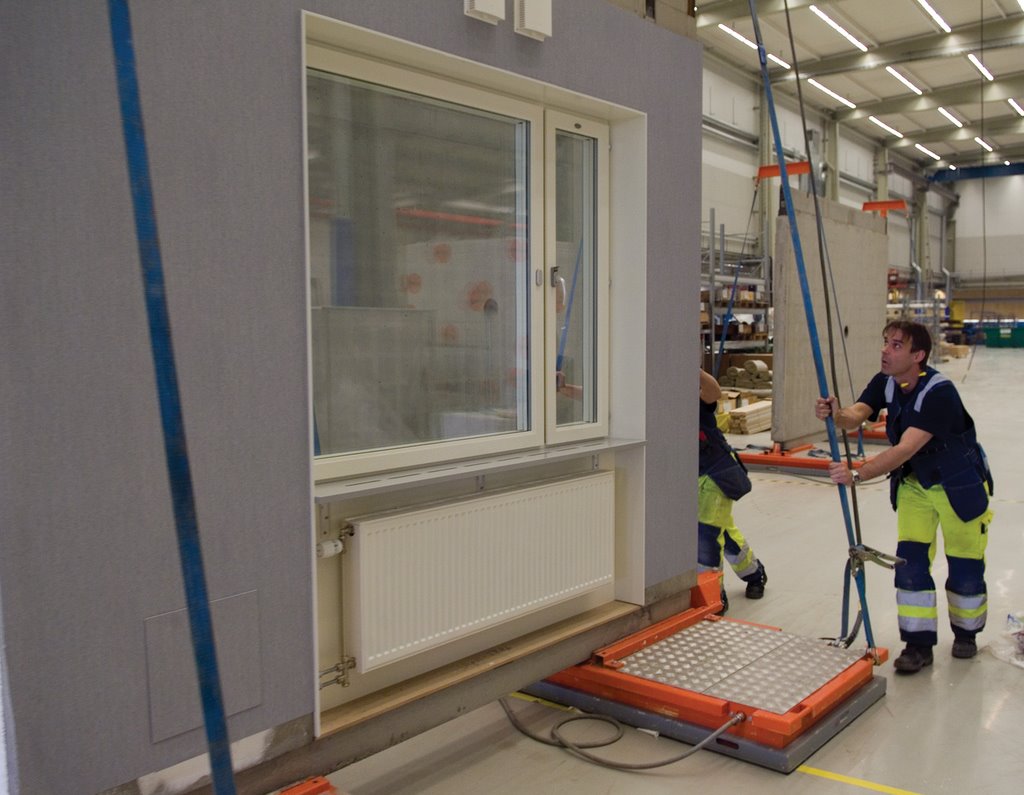
Swedish contractor NCC has created a quite revolutionary factory for producing prefab houses. Usually 90% of construction is done at the building site. With this concept, 90% of construction is done in the controlled and automated factory environment. The assembly on site is done underneath a giant tent, so no water damage etc.
NCC claims that they have cut production time for housing in half.
There's a 7 minute film about the concept at their website.

Dawkin's back

There's a number of podcast out there with excellent speeches and interviews with Richard Dawkins talking about his latest book "The God delusion".

- A twenty minute speech at TED talks
- An hour long interview on point of inquiry

He speeks eloquently on the dangers of blindly accepting religius dogma and explanations based on faith. Very refreshing.

I transcribed this snippet from his recent speech Poptech - which is not online yet:

Science has taught us many things against our intuition. Appearantly solid things like crystals and rocks are almost entirely empty space – the familiar illustration is a fly in the middle of a sports stadium. The nucleus is the fly in the middle of the sports stadium and the next nucleus is the next fly in the middle of the next sports stadium.
The hardest, densest rock is ”really” almost entirely empty space, broken only by tiny particles so widely spaced they shouldn’t count. Why then do rocks feel hard and solid and impenetrable. Well, as an evolutionary biologist I’d say something like this: Our brain has evolved to help us survive within the orders of magnitude of size and speed at which our body normally operates. We never evolved to navigate in the world of atoms – if we had, our brains would probably percieve rocks as full of empty space.
Rocks feel hard and impenetrable to our hands because our hands themselves can’t penetrate them. It’s therefore useful to our brians to construct notions like solidity and impenetrability.
Moving to the other end of the scale, our ancestors never had to move through the cosmos at anything like the speed of light, if they had our brains would be much better equipped to deal with Einsteins ideas of relativity.
I give the name middleworld to the medium scale environment, the things moving at medium speeds , in which we have evolved, in which our brains have evolved to understand and take action.

Friday, October 27, 2006

A long wait for a good beer - Guinness evolution ad


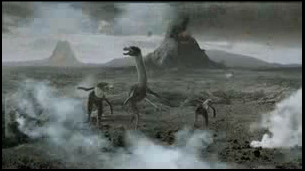
Just saw this amazing ad for Guinness, three guys in a pub that suddenly get thrown backward in evolution, 3 billion years to the point where they lizards drinking foul water at some pond. Sometimes ads are so great.

Monday, October 23, 2006

The singularity summit as podcasts

So much good stuff, so little time.
There’s a number of very good talks available as podcasts from the Singularity Summit at Stanford – back in may.
A little snippet: In his speech Cory Doctorow has a good description of the fundamental problem with controlling the network with heavy-handed Digital rights management:

All complex systems have parasites and you can’t solve parasites by rendering the system simple. Solving the parasites by rendering the system simple renders the system not powerful enough to not even bother with.

Mega cities on display in Venice


The biennale on architecture in Venice is well worth a visit – you should reserve two days for it, there’s a lot to see. It’s hard work, but luckily there’s all of that wonderful Italian coffee to pick you up.
It closes on november 18th.

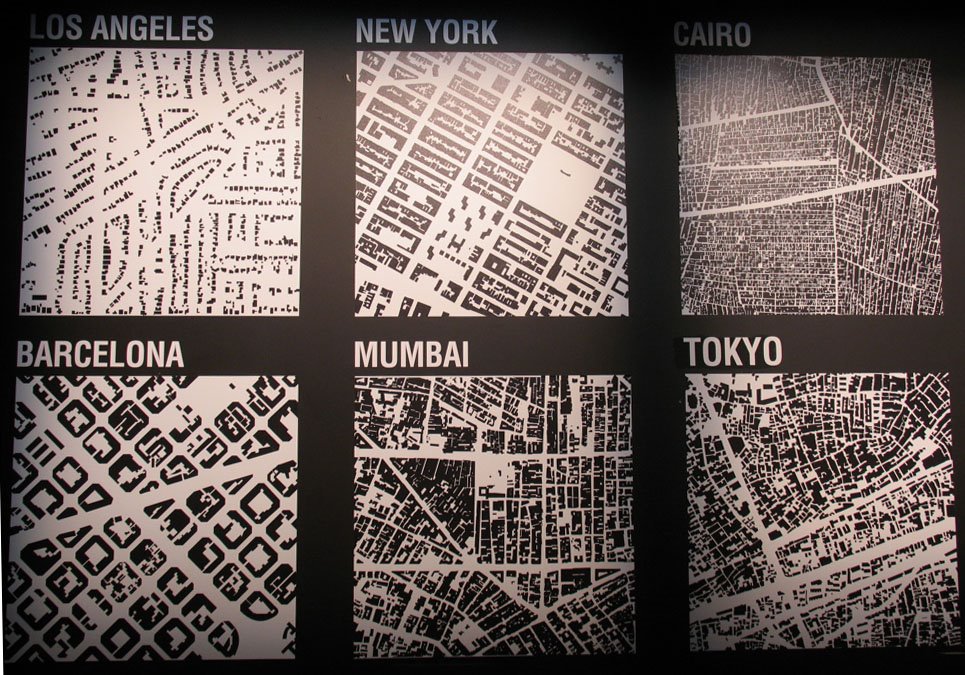
The theme this time is Mega cities, and the main exhibition looks at 16 major cities: Caracas, Cairo, Mexico City, Cairo, Berlin, Shanghai, Istanbul and Los Angeles are among them.
Lots of good analysis, breathtaking multimedia, amazing photos and interesting facts. Such as:
There’s one square meter of free space pr. Inhabitant in Cairo.
In 2050 8 billion people will be living in cities - 3/4 of the worlds population, as opposed to just over half today.
The worlds largest city currently is the greater Tokyo metropolitan area with 34 mio. Inhabitants. By 2050 Mumbai is expected to be the largest. It’s currently 18 mio. But will likely be over 40 mio. Then.
In Los Angeles 80% of all transportation is in cars, In Tokyo 80% of transportation uses trains and buses.
The typical daily commuting time in Sao Paolo, Brasil is 4-5 hours.
Half of all cement in the world is used in China. Shanghai alone added 2700 skyscrapers in the past ten years, increasing the number of hi-rises tenfold.
60% of Mexico Cities inhabitants are squatters. The rates for ”informal” occupancy is similar in many third mega-cities.

The impression I got away with was that of to very strong, opposing forces, top-down and bottom-up. One is city planning and architecture on an absolutely massive, soviet style scale. The exhibition shows any number of very large projects for brand new cities with hundreds of thousands of inhabitants – particularly for Asia.
The other force is the flood of poor people simply moving to the city, putting up their shacks where it’s possible. Seen from above, it looks like a sea of corrugated tin roofs and muddy roads swallowing the old, official cities.
The Venezuelan pavilion is about the slums of Caracas. On a wall-size sign it’s states something like: These people have no use for architects. This sort of city does not look like someone intended. But perhaps, the solutions that the people in the slums find to solve the extreme pressure on resources could be used by all of us.

For old times sake I did a radio-report for Radio Denmarks Orientering.
It’s in Danish, though. You can hear it here.

Sunday, October 22, 2006

Craig Venter at Poptech


I missed Poptech this year, but very generously the amazing Poptech team streamed the whole conference - so I’ve kinda been there, at least virtually.
The one talk I was really looking forward to was Craig Venter – of decoding the human genome fame. He came on as the last speaker. He’s almost scary in his laser like determination and belief in what he’s doing, but I get this feeling that we’d better listen. He’s working on “synthetic biology”, his project is to create new life from the bottom up, bacteria which can be tailored to do Really Usefull Stuff – like eating CO2 and turning it into energy for us to use.
It’s a wonderful prospect, but I can see a million things going wrong before we can relax about large scale use of synthetic bacteria.
The following passage of Venter’s speech gets into some of the details. Sounds to me like he’s spelling out the future - although I’m not sure that I’ve gotten all the spelling right:

No cells’ genome has yet been even remotely synthesized and even genome replacement has not yet been demonstrated. So we’re early on, but we think there’s tremendous use for this key technology as we go forward.
This audience clearly knows about energy demand and the potential to develop new fuels. My view is coming a little bit from a different side in terms of what we are doing to the environment; We’re adding 3,5 billion tons of CO2 to the atmosphere each year, we can not afford to ignore any technology that offers a solution.
We’ve designed, on paper, organisms that can take that CO2 back from the atmosphere and fix the CO2 into cellular proteins, sugars, biopolymers etc. Just recently Dupont has opened a plant in Tennessee that has silos, 4 of them, about the size of this room, for producing propanediol from sugar, that goes into their new ceronapolymer that’s going to be used for stain free carpets and clothing - all derived from modifying the genome of a bacteria. They are starting with sugar, but we can go back further, to CO2.
We have metabolic pathways that can take carbon monoxide out of the air, split water with that, producing hydrogen and oxygen. We can go from methane to produce hydrogen or other fuels. We have a team working on modifying photosynthesis to go straight from sunlight into hydrogen production without any other energy being added - and we and others have been working on modifying cells to produce burnable fuels directly.
So cellulasis, or enzymes that break down the complex sugars that form plants and trees – everybody knows that termites can eat wood but in fact termites can not eat wood, they have bacteria in their guts, the cellulasis, that break down the cellulose into simple sugars.
The goal is to convert some of agriculture where we can capture back some of this carbon in a recyclable fashion. People are starting with ethanol but there is no reason why in a few years time we can’t go right from cellulose through a bacteria to make butane, propane, even octane directly.
Now all of a sudden, in stead of taking carbon from the ground, burning it and putting it in the atmosphere we can recycle it through the process of photosynthesis. We’re looking at a wide variety of plants as feed stocks, going into producing chemicals as Dupont is doing, for nutraceuticals and most importantly into energy - in terms of what we are rapidly doing to this planet.
I’m the least worried about disease, whether it’s manmade or new emerging infections affecting humanity. In the long term. if we destroy our spaceship, which we are in the process of doing, disease will not matter.

Tuesday, September 19, 2006

I’m so fed up with ”innovation”

I write a bi-weekly column for the Danish edition of computerworld. Here's a sample in translation:

It’s hard to have a civilized discussion these days without using the term ”innovation”. We all know the refrain: We are living in different times, and in the future we will all have to be creative for a living.
...I think we’ve all pretty much understood that by now.
The problem with the word ”innovation” is that it suggests that we’re all going to run around spewing great ideas 8 hours a day. While in fact it’s a much broader set of competences that we need.

In primary schools one uses the term ”litteracies”, to describe the basic skills that are necessary in order to get by in society. In Denmark the law emphasizes 5 litteracies: reading, writing, math, English as second language, and basic IT skills. If you lack one or more of these, you will experience that the doors to further learning are shut.

What’s considered basic litteracies obviously changes as the conditions in society change. As we shift from the industrial society to a networked society we will need to acquire a number of new, basic competences to supplement the old litteracies. I would argue that it’s really this new set of competencies that’s being called for, when politicians, business leaders and columnists demand that we learn to be ”innovative”.

I realize that the following will sound pretty theoretical, but, put briefly, I believe that the competences we need are about understanding the new game rules in a globally connected, complex, dynamic system.

The world is being ever tighter coupled and developments in completely different areas increasingly affect eachother. Furthermore, changes in the global system are accellerating, as each new technical development makes us capable of taking the next step forward even faster.
This makes it crucial to have mechanisms like evolution, non-linearity, feedback, self-organization and ecology completely internalized in the way we assess situations and act in accordance with the realities of today and the coming years. One needs to be familiar with these mechanisms in order to understand such phenomena as the internet, international politics, a market place or how a living system – like our own body – functions.

Paradoxically, we are experiencing an increasing individualization concurently with the growing connectivity and interdependence. Ever more of us are reaching a level of education and wealth at which we can start demanding a high degree of individual freedom and service. However, this freedom implies a growing personal responsibility. All of us must learn to be pro-active and manage a personal strategy of development – for instance by maintaining our level of knowledge and our health.
The world has become interactive. In contrast to the dominating mass culture of industrialism we are now increasing co-creators – and thus co-responsible – for the relevance of our work and for the shaping of the products and service we use. We can’t get by like in the industrial age, relying on top-down hierachies in which most people just did what they were told to do.

We need a new approach which is compatible with the new conditions of this new age. At a fundamental level it’s about seeing change as the natural state of affairs. Increasingly, we will produce and consume processes, that are continuously adjusted to fit the users changing contexts at a speed that approaches realtime.
Thus, we need to get accustomed and feel at ease thinking in terms of probabilities and adhoc solutions rather than certainties and stability. In order to participate in the global interaction we must be open minded and explorative, willing to share experiences, able to communicate and receptive to input from others.
... Oh, and of course we also need to be creative in order to find new solutions and to use our knowledge in ever changing contexts. Innovation is crucial – but in my understanding it only covers a fraction of an entirely new mindset that we need to make the basis of our educations.
I wish I could innovate a better word for it.

Wednesday, August 23, 2006

Terraforming in Holland


...while I’m at it: Here’s another amazing landscape. It’s just north of Rotterdam in the Netherlands. The area is known as Glaslaan; the glass region.
What you see are greenhouse, massive stretches of enormous greenhouses. I spent a whole day photographing the surrealism of the place a few years back.

That giant sucking sound


I am working on a presentation about water and I was looking for images that would illustrate how much water is used for irrigation – often in areas that basically are not suited for intensive agriculture at all.
(fact: 70% of global water consumption is for irrigation).

I heard that Garden City in Kansas was a place that used pivot irrigation a lot, and sure enough: if you have a look from the Google Earth satellite, you see this massive example of terraforming.
I can't help wondering what the view will be in a few decades.

Monday, August 21, 2006

Freedom and responsibility

Come to think of it it’s actually very simple:
Freedom and responsibility are intertwined in the sense that the more freedom you have in choosing your actions, the more those actions will be your responsibility.

Saturday, August 12, 2006

Weird World War

What drives me nuts about this war is: What are we fighting about?
I'd love to see some demands for change, something concrete to get a discussion going.
Have I overlooked something?

Thursday, August 10, 2006

Freestyle computing - tell your kids


At Danfoss Universe, we just launched a pet project of mine, the freestyle computing competition – alas only in Denmark.
The competition is open for kids below 16. They can submit any creation that has computing involved in it – animation, websites, photoshop stuff, ring tones for phones, robots, whatever...
The jury will find the coolest production, emphasizing originality, technical skill, and the ability to combine several media.
We have two age brackets; up to 11, and 11-15 years. The winner in each bracket gets an i-pod – but every entrant recieves an evaluation from the jury.
The concept is heavily inspired by the u19 contest that is part of Prix Ars Electronica in Linz, Austria, and the Ars Electronica folks have been very helpful in discussing their experiences with us – they rock!

Our ambitions are to build this into a broadcast event, it seems obvious, considering the succes of the many current TV shows where young untried talents get a chance to show off.

For Danfoss Universe, it’s part of our mission to stimulate the interest and understanding of natural science and technology. We believe that encouraging selfexpression and communication through new uses of digital technology is as good a way to learn about technology as any.

We will post some of the works on our online gallery as we recieve them. I’m really looking forward to see what will come, I have a feeling it will be amazing.