I write a bi-weekly column for the Danish edition of computerworld. Here's a sample in translation:
It’s hard to have a civilized discussion these days without using the term ”innovation”. We all know the refrain: We are living in different times, and in the future we will all have to be creative for a living.
...I think we’ve all pretty much understood that by now.
The problem with the word ”innovation” is that it suggests that we’re all going to run around spewing great ideas 8 hours a day. While in fact it’s a much broader set of competences that we need.
In primary schools one uses the term ”litteracies”, to describe the basic skills that are necessary in order to get by in society. In Denmark the law emphasizes 5 litteracies: reading, writing, math, English as second language, and basic IT skills. If you lack one or more of these, you will experience that the doors to further learning are shut.
What’s considered basic litteracies obviously changes as the conditions in society change. As we shift from the industrial society to a networked society we will need to acquire a number of new, basic competences to supplement the old litteracies. I would argue that it’s really this new set of competencies that’s being called for, when politicians, business leaders and columnists demand that we learn to be ”innovative”.
I realize that the following will sound pretty theoretical, but, put briefly, I believe that the competences we need are about understanding the new game rules in a globally connected, complex, dynamic system.
The world is being ever tighter coupled and developments in completely different areas increasingly affect eachother. Furthermore, changes in the global system are accellerating, as each new technical development makes us capable of taking the next step forward even faster.
This makes it crucial to have mechanisms like evolution, non-linearity, feedback, self-organization and ecology completely internalized in the way we assess situations and act in accordance with the realities of today and the coming years. One needs to be familiar with these mechanisms in order to understand such phenomena as the internet, international politics, a market place or how a living system – like our own body – functions.
Paradoxically, we are experiencing an increasing individualization concurently with the growing connectivity and interdependence. Ever more of us are reaching a level of education and wealth at which we can start demanding a high degree of individual freedom and service. However, this freedom implies a growing personal responsibility. All of us must learn to be pro-active and manage a personal strategy of development – for instance by maintaining our level of knowledge and our health.
The world has become interactive. In contrast to the dominating mass culture of industrialism we are now increasing co-creators – and thus co-responsible – for the relevance of our work and for the shaping of the products and service we use. We can’t get by like in the industrial age, relying on top-down hierachies in which most people just did what they were told to do.
We need a new approach which is compatible with the new conditions of this new age. At a fundamental level it’s about seeing change as the natural state of affairs. Increasingly, we will produce and consume processes, that are continuously adjusted to fit the users changing contexts at a speed that approaches realtime.
Thus, we need to get accustomed and feel at ease thinking in terms of probabilities and adhoc solutions rather than certainties and stability. In order to participate in the global interaction we must be open minded and explorative, willing to share experiences, able to communicate and receptive to input from others.
... Oh, and of course we also need to be creative in order to find new solutions and to use our knowledge in ever changing contexts. Innovation is crucial – but in my understanding it only covers a fraction of an entirely new mindset that we need to make the basis of our educations.
I wish I could innovate a better word for it.
Tuesday, September 19, 2006

Wednesday, August 23, 2006
Terraforming in Holland


...while I’m at it: Here’s another amazing landscape. It’s just north of Rotterdam in the Netherlands. The area is known as Glaslaan; the glass region.
What you see are greenhouse, massive stretches of enormous greenhouses. I spent a whole day photographing the surrealism of the place a few years back.

That giant sucking sound

I am working on a presentation about water and I was looking for images that would illustrate how much water is used for irrigation – often in areas that basically are not suited for intensive agriculture at all.
(fact: 70% of global water consumption is for irrigation).
I heard that Garden City in Kansas was a place that used pivot irrigation a lot, and sure enough: if you have a look from the Google Earth satellite, you see this massive example of terraforming.
I can't help wondering what the view will be in a few decades.

Monday, August 21, 2006
Freedom and responsibility
Come to think of it it’s actually very simple:
Freedom and responsibility are intertwined in the sense that the more freedom you have in choosing your actions, the more those actions will be your responsibility.
Freedom and responsibility are intertwined in the sense that the more freedom you have in choosing your actions, the more those actions will be your responsibility.
Saturday, August 12, 2006
Weird World War
What drives me nuts about this war is: What are we fighting about?
I'd love to see some demands for change, something concrete to get a discussion going.
Have I overlooked something?
I'd love to see some demands for change, something concrete to get a discussion going.
Have I overlooked something?
Thursday, August 10, 2006
Freestyle computing - tell your kids

At Danfoss Universe, we just launched a pet project of mine, the freestyle computing competition – alas only in Denmark.
The competition is open for kids below 16. They can submit any creation that has computing involved in it – animation, websites, photoshop stuff, ring tones for phones, robots, whatever...
The jury will find the coolest production, emphasizing originality, technical skill, and the ability to combine several media.
We have two age brackets; up to 11, and 11-15 years. The winner in each bracket gets an i-pod – but every entrant recieves an evaluation from the jury.
The concept is heavily inspired by the u19 contest that is part of Prix Ars Electronica in Linz, Austria, and the Ars Electronica folks have been very helpful in discussing their experiences with us – they rock!
Our ambitions are to build this into a broadcast event, it seems obvious, considering the succes of the many current TV shows where young untried talents get a chance to show off.
For Danfoss Universe, it’s part of our mission to stimulate the interest and understanding of natural science and technology. We believe that encouraging selfexpression and communication through new uses of digital technology is as good a way to learn about technology as any.
We will post some of the works on our online gallery as we recieve them. I’m really looking forward to see what will come, I have a feeling it will be amazing.
Tuesday, August 01, 2006
A chilled experience

It’s a scorching summers’ day outside in Toronto, but I’m shivering in the airconditioning of the cinema where I’m finally watching Al Gore’s ”An inconvenient truth”.
They’ve done a great job in my opinion. Gore tells that he has given his climate presentation at least a thousand times, and a good part of the film shows him polishing and editing the show.
There’s a lot of pictures of Gore staring pensively out windows into the distance and, to me, some of the personal stuff gets a bit thick – but maybe that’s what you need in order to make it more compelling, and less like a lecture. Basically, if this movie can’t get the message across, I can’t imagine what will – apart from dire necessity, of course.
Still, it’s not exactly a blockbuster movie: I shared the cold theater with 4 others, but of course it’s been a couple of months since release by now.
So, now I’ve heard the podcast, read the book, seen the movie – It’s time to try to invite the man over to Denmark to spread the gospel.
Monday, July 31, 2006
The future according to the futurists
So, after 3 days of discussing the future at the futurists conference, what does the future look like? Well, not too inviting, I’m afraid.
I’ve been looking at the future for a couple of decades now, and I can’t recall that there has been such a sense of gloom concerning the coming years. You can go to session after session and people will be discussing global warming, epidemics, singularities leaving us in the dust, terrorism... You are incessantly confronted with exponential curves leading us to what looks like hell on earth – at accellerating speeds.
The only hopeful scenarios – those where continued technological progress manages to stave off the various problems of ressources, environmental degradation and health– all seem to take us into a very different existance as radically enhanced fusions of man and machine in societies with very different values. And that doesn’t look too tempting either.
Worse of all; all the well meaning solutions that people suggest; global governance, legislation and treaties, a new consiousness, various think tanks... it all sounds so totally inadequate, naive and somehow just plain boring. Maybe we can dampen things a bit by holding back, but frankly I doubt that you can get sufficient traction among the global masses of consumers and corporations.
I find that the things that do offer hope tend to be very concrete, practical action-based projects that prove that it’s possible to live a fullfilling life outside the logic that we seem to be stuck within. Often they are very local projects, but something like GEs Ecomagination efforts are inspiring too.
In conclusion: The shits seems to be hitting the fan for real – but, a lot of smart people have become acutely aware of this recently.
I’ve been looking at the future for a couple of decades now, and I can’t recall that there has been such a sense of gloom concerning the coming years. You can go to session after session and people will be discussing global warming, epidemics, singularities leaving us in the dust, terrorism... You are incessantly confronted with exponential curves leading us to what looks like hell on earth – at accellerating speeds.
The only hopeful scenarios – those where continued technological progress manages to stave off the various problems of ressources, environmental degradation and health– all seem to take us into a very different existance as radically enhanced fusions of man and machine in societies with very different values. And that doesn’t look too tempting either.
Worse of all; all the well meaning solutions that people suggest; global governance, legislation and treaties, a new consiousness, various think tanks... it all sounds so totally inadequate, naive and somehow just plain boring. Maybe we can dampen things a bit by holding back, but frankly I doubt that you can get sufficient traction among the global masses of consumers and corporations.
I find that the things that do offer hope tend to be very concrete, practical action-based projects that prove that it’s possible to live a fullfilling life outside the logic that we seem to be stuck within. Often they are very local projects, but something like GEs Ecomagination efforts are inspiring too.
In conclusion: The shits seems to be hitting the fan for real – but, a lot of smart people have become acutely aware of this recently.
Saturday, July 29, 2006
TV crap
Sorry to drone on about energy, but:
Just happened to see this ridiculous TV ad for the Hummer.
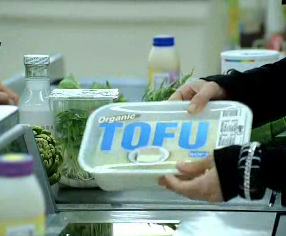
It starts out with a healthy, green-clad young man in a supermarket checkout, buying tofu and other deplorably bland, veggie stuff.
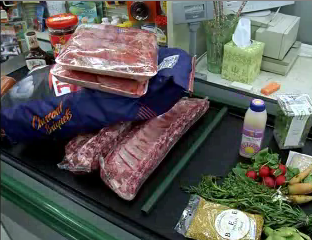
Right after him comes another guy who gets loads of meat, a bottle of alcohol and other tempting goodies. Our young green protagonist grows VERY frustrated.
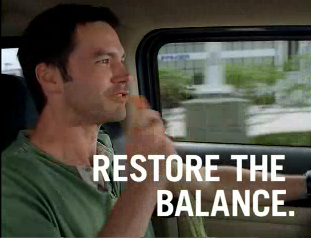
So he runs out and buys himself a hummer. Yeah! So finally he can eat a carrot with a smile. The caption reads: Restore the balance.
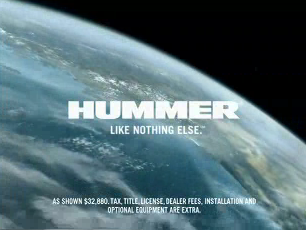
And of course it all ends with the Hummer logo over a shot of mother earth seen from space.
Wow! I guess I should start saving up for one too.
Just happened to see this ridiculous TV ad for the Hummer.

It starts out with a healthy, green-clad young man in a supermarket checkout, buying tofu and other deplorably bland, veggie stuff.
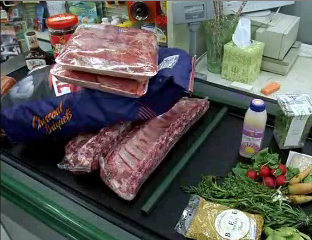
Right after him comes another guy who gets loads of meat, a bottle of alcohol and other tempting goodies. Our young green protagonist grows VERY frustrated.

So he runs out and buys himself a hummer. Yeah! So finally he can eat a carrot with a smile. The caption reads: Restore the balance.

And of course it all ends with the Hummer logo over a shot of mother earth seen from space.
Wow! I guess I should start saving up for one too.
Sleepless in Toronto
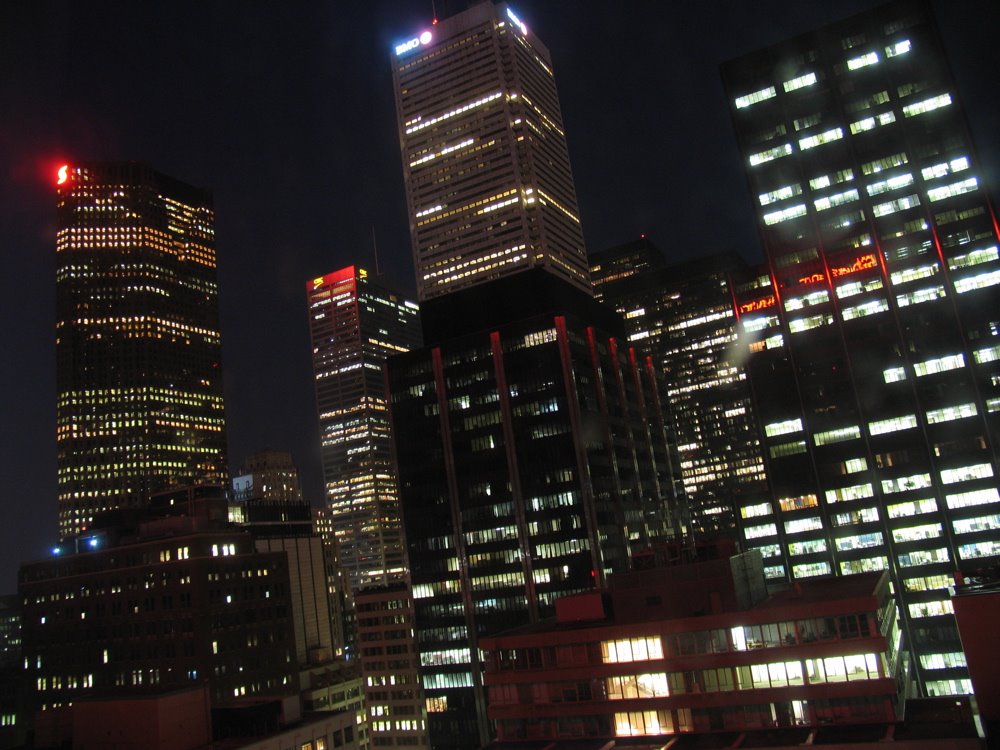
5 AM saturday morning, the view from my window is a wall of offices, almost half of them have the lights left on for the night – and in this case, the entire weekend. No sign of anyone working in any of those many rooms.
Canada seems as determined to waste energy as anyone else. At least, you can take comfort in the realization that there are plenty of easy ways to reduce the energy-load considerably. Just turn the light off when you leave.
The future is un-predictable
I’m at the world future society’s annual meeting – this year in Toronto. And boy, does the future ever look un-predictable. Seems we’re going in many different, mutually exclusive, directions at once.
Just to name a few: Turning back the burning of fossil fuels to anything near sustainable levels looks rather unfeasible on a 30 – 50 year timescale – So, we’re cooking the planet, with a lot of ensuing suffering in all kinds of ways.
Or: Will nano and bio-tech combined instead lift us out of the mess, make us capable of creating anything we like at low cost, solve the energy crisis, make everything recyclable, and change us into a new species of super-smart cyborgs in the process – in pretty much those same 30 – 50 years. Or less.
Just to name a few: Turning back the burning of fossil fuels to anything near sustainable levels looks rather unfeasible on a 30 – 50 year timescale – So, we’re cooking the planet, with a lot of ensuing suffering in all kinds of ways.
Or: Will nano and bio-tech combined instead lift us out of the mess, make us capable of creating anything we like at low cost, solve the energy crisis, make everything recyclable, and change us into a new species of super-smart cyborgs in the process – in pretty much those same 30 – 50 years. Or less.
Wednesday, July 12, 2006
Major mindless damage
The Herald tribune has this amazing article about how wasteful the Russian energy production and distribution is.
In the article the director of the International Energy Agency, Claude Mandil, specifically critizes the widespread practice of gas flaring - that is, burning off gas at oil wells.
"Between 40 billion cubic meters and 60 billion cubic meters a year are being burned in Russia," he said. "That is about a quarter of the 200 billion cubic meters of gas Russia exports to Europe a year."
According to the World Bank, each year about 150 billion cubic meters of natural gas is flared off - equivalent to 30 percent of the European Union's gas consumption.
Developing countries account for more than 85 percent of gas flaring and venting, including Nigeria, Russia, Iran, Iraq, Angola and Qatar.
In Russia, "gas flaring exists because today Gazprom is the only one that can buy this gas," Mandil said. "It buys this gas at such a low price that producers do not see the reason to build a small pipeline that could bring this gas from the field to the trunk line."
So much for avoiding the greenhouse effect...
In the article the director of the International Energy Agency, Claude Mandil, specifically critizes the widespread practice of gas flaring - that is, burning off gas at oil wells.
"Between 40 billion cubic meters and 60 billion cubic meters a year are being burned in Russia," he said. "That is about a quarter of the 200 billion cubic meters of gas Russia exports to Europe a year."
According to the World Bank, each year about 150 billion cubic meters of natural gas is flared off - equivalent to 30 percent of the European Union's gas consumption.
Developing countries account for more than 85 percent of gas flaring and venting, including Nigeria, Russia, Iran, Iraq, Angola and Qatar.
In Russia, "gas flaring exists because today Gazprom is the only one that can buy this gas," Mandil said. "It buys this gas at such a low price that producers do not see the reason to build a small pipeline that could bring this gas from the field to the trunk line."
So much for avoiding the greenhouse effect...
Friday, June 09, 2006
Snapshots from the future

I have a new book out!
It’s called Snapshots from the future, and it’s 7 short stories that describe life in about 25 years time – give or take a decade.
The book is published in Danish, but the text has been translated into English and the whole thing is posted at the website of Danfoss Universe.
For years I’ve wanted to create something like a cartoon, with a heavy emphasis on pictures and a narrative form to engage readers more emotionally. I’ve tried to keep light and inviting – but the underlying facts are never the less a quite serious attempt to destill years of future studies into a coherent picture.
It can be read by kids at about 15 years, but it’s not meant to be just for school. I would hope that anyone trying to make sense of the future could find some inspiration in it.
For me, the book has turned out pretty much exactly how I wished it – which is very satisfying, of course. The project has been a lot of fun. My old friend and colleague Henrik Føhns made it happen by agreeing to print the articles in the Danish magazine Samvirke – and by suggesting the book project in the first place (tak for det, Føhns!). Emil Landgreen has created some great and beautiful illustrations and fake advertisements.
So have a look – and let me know what you think.
Oh, and for Danes who want to buy the printed version:
FDBs Skolekontakt sells them, either 59 kr. for a copy or 350 kr. for a set of 30 copies.
Tuesday, May 23, 2006
Go ahead, emit!
Wow, this is seriously weird. Some organisation called "Competetive enterprise Institute" (sponsored by Exxon-mobil among others) has produced two very slick TV-ads that promote CO2. We call it life, they say. Check 'em out, you need to see this.
Monday, May 22, 2006
GE Ecomagination publishes first annual report

GE has just published a report/36 page advertising that describes the first year of their Ecomagination initiativ. It’s not perfect, some may think it’s mostly greenwash, but I happen to be impressed. It’s a very big company and taking it through this kind of re-orientation can not be easy. It’s an audacious undertaking, and it has real impact. Respect!
From the report:
Specifically, GE has pledged to:
Double its investment in clean R&D—GE is growing
its research in cleaner technologies from $700 million
in 2005 to $1.5 billion in 2010.
Increase revenues from ecomagination products—
GE will grow revenues from products and services that
provide significant and measurable environmental performance
advantages to customers—to at least $20 billion
in 2010, with more aggressive targets thereafter.
Reduce its greenhouse gas (GHG) emissions and improve
the energy efficiency of its operations—GE is committed to
reduce its GHG emissions 1% by 2012, reduce the intensity
of its GHG emissions 30% by 2008, and improve energy
efficiency 30% by the end of 2012 (all compared to 2004.)
Without this action, GHG emissions were predicted to rise
substantially by 2012, based on GE’s projected growth.
Keep the public informed—This report is just one way GE
will publicly report its progress in meeting these goals.
What’s so inconvenient about climate change?
Attempting to reduce climate change demands us to change our lifestyle at a very basic level. In one sense it represents a reversal of a development that has been a main characteristic of humanity.
The story of human development is intimately linked to our increasing power and freedom to connect and move around over ever larger distances.
With the technology that is likely to be available in the foreseeable future, avoiding climate change by reducing CO2 emissions, will require us to reverse that. So: Less jetting and driving around, less long distance trade, less freedom to choose whatever we want anywhere and anytime.
There are a lot of very good reasons to wish that we can continue towards higher connectivity, a cosmopolitan society, more comfort. It’s a big part of desires of modern man and woman: this slick world where humans get what we want - now.
Giving it up is not only inconvenient - somehow it feels like crawling backwards in the evolutionary tree.
The story of human development is intimately linked to our increasing power and freedom to connect and move around over ever larger distances.
With the technology that is likely to be available in the foreseeable future, avoiding climate change by reducing CO2 emissions, will require us to reverse that. So: Less jetting and driving around, less long distance trade, less freedom to choose whatever we want anywhere and anytime.
There are a lot of very good reasons to wish that we can continue towards higher connectivity, a cosmopolitan society, more comfort. It’s a big part of desires of modern man and woman: this slick world where humans get what we want - now.
Giving it up is not only inconvenient - somehow it feels like crawling backwards in the evolutionary tree.
Saturday, May 20, 2006
SAS Airlines offers emission calculator

You can't really say you don't know. SAS has created a web-service so passengers can see the emissions that the flight they are booking will cause.
Great idea, although it's very well hidden if you are accessing their website from the frontpage. I only found it because I had been given the direct link.
Al Gore on global warming

The trailer for "The incovenient truth", a new film with Al Gore presenting the scary low-down on climate change is out, as well as an extensive website with scientific facts, a calculator to see just how much damage you're doing, and the inevitable blog.
Judging from the trailer, it looks like a very powerful piece of argumentation - the Hollywood drama and bombastic music is not quite to my liking, but I have a sense that this might be what it takes to really get the message out.
It's a terrible situation we're facing - but at last it looks like the issue will emerge from denial. Next step is some action, but, uh, that's the hard part. Very inconvenient, indeed.
Monday, May 15, 2006
Heatwave in dense environment

They've had a heatwave in India and Pakistan this weekend, with temperature reaching 49 degrees celcius in some places. Not very comfortable we can assume.
Saturday, May 13, 2006
Big elephant in London

By chance I ran into this last weekend in London. Never quite found out what the point was.
Subscribe to:
Posts (Atom)