I’m at the world future society’s annual meeting – this year in Toronto. And boy, does the future ever look un-predictable. Seems we’re going in many different, mutually exclusive, directions at once.
Just to name a few: Turning back the burning of fossil fuels to anything near sustainable levels looks rather unfeasible on a 30 – 50 year timescale – So, we’re cooking the planet, with a lot of ensuing suffering in all kinds of ways.
Or: Will nano and bio-tech combined instead lift us out of the mess, make us capable of creating anything we like at low cost, solve the energy crisis, make everything recyclable, and change us into a new species of super-smart cyborgs in the process – in pretty much those same 30 – 50 years. Or less.
Saturday, July 29, 2006

Wednesday, July 12, 2006
Major mindless damage
The Herald tribune has this amazing article about how wasteful the Russian energy production and distribution is.
In the article the director of the International Energy Agency, Claude Mandil, specifically critizes the widespread practice of gas flaring - that is, burning off gas at oil wells.
"Between 40 billion cubic meters and 60 billion cubic meters a year are being burned in Russia," he said. "That is about a quarter of the 200 billion cubic meters of gas Russia exports to Europe a year."
According to the World Bank, each year about 150 billion cubic meters of natural gas is flared off - equivalent to 30 percent of the European Union's gas consumption.
Developing countries account for more than 85 percent of gas flaring and venting, including Nigeria, Russia, Iran, Iraq, Angola and Qatar.
In Russia, "gas flaring exists because today Gazprom is the only one that can buy this gas," Mandil said. "It buys this gas at such a low price that producers do not see the reason to build a small pipeline that could bring this gas from the field to the trunk line."
So much for avoiding the greenhouse effect...
In the article the director of the International Energy Agency, Claude Mandil, specifically critizes the widespread practice of gas flaring - that is, burning off gas at oil wells.
"Between 40 billion cubic meters and 60 billion cubic meters a year are being burned in Russia," he said. "That is about a quarter of the 200 billion cubic meters of gas Russia exports to Europe a year."
According to the World Bank, each year about 150 billion cubic meters of natural gas is flared off - equivalent to 30 percent of the European Union's gas consumption.
Developing countries account for more than 85 percent of gas flaring and venting, including Nigeria, Russia, Iran, Iraq, Angola and Qatar.
In Russia, "gas flaring exists because today Gazprom is the only one that can buy this gas," Mandil said. "It buys this gas at such a low price that producers do not see the reason to build a small pipeline that could bring this gas from the field to the trunk line."
So much for avoiding the greenhouse effect...
Friday, June 09, 2006
Snapshots from the future

I have a new book out!
It’s called Snapshots from the future, and it’s 7 short stories that describe life in about 25 years time – give or take a decade.
The book is published in Danish, but the text has been translated into English and the whole thing is posted at the website of Danfoss Universe.
For years I’ve wanted to create something like a cartoon, with a heavy emphasis on pictures and a narrative form to engage readers more emotionally. I’ve tried to keep light and inviting – but the underlying facts are never the less a quite serious attempt to destill years of future studies into a coherent picture.
It can be read by kids at about 15 years, but it’s not meant to be just for school. I would hope that anyone trying to make sense of the future could find some inspiration in it.
For me, the book has turned out pretty much exactly how I wished it – which is very satisfying, of course. The project has been a lot of fun. My old friend and colleague Henrik Føhns made it happen by agreeing to print the articles in the Danish magazine Samvirke – and by suggesting the book project in the first place (tak for det, Føhns!). Emil Landgreen has created some great and beautiful illustrations and fake advertisements.
So have a look – and let me know what you think.
Oh, and for Danes who want to buy the printed version:
FDBs Skolekontakt sells them, either 59 kr. for a copy or 350 kr. for a set of 30 copies.
Tuesday, May 23, 2006
Go ahead, emit!
Wow, this is seriously weird. Some organisation called "Competetive enterprise Institute" (sponsored by Exxon-mobil among others) has produced two very slick TV-ads that promote CO2. We call it life, they say. Check 'em out, you need to see this.
Monday, May 22, 2006
GE Ecomagination publishes first annual report

GE has just published a report/36 page advertising that describes the first year of their Ecomagination initiativ. It’s not perfect, some may think it’s mostly greenwash, but I happen to be impressed. It’s a very big company and taking it through this kind of re-orientation can not be easy. It’s an audacious undertaking, and it has real impact. Respect!
From the report:
Specifically, GE has pledged to:
Double its investment in clean R&D—GE is growing
its research in cleaner technologies from $700 million
in 2005 to $1.5 billion in 2010.
Increase revenues from ecomagination products—
GE will grow revenues from products and services that
provide significant and measurable environmental performance
advantages to customers—to at least $20 billion
in 2010, with more aggressive targets thereafter.
Reduce its greenhouse gas (GHG) emissions and improve
the energy efficiency of its operations—GE is committed to
reduce its GHG emissions 1% by 2012, reduce the intensity
of its GHG emissions 30% by 2008, and improve energy
efficiency 30% by the end of 2012 (all compared to 2004.)
Without this action, GHG emissions were predicted to rise
substantially by 2012, based on GE’s projected growth.
Keep the public informed—This report is just one way GE
will publicly report its progress in meeting these goals.
What’s so inconvenient about climate change?
Attempting to reduce climate change demands us to change our lifestyle at a very basic level. In one sense it represents a reversal of a development that has been a main characteristic of humanity.
The story of human development is intimately linked to our increasing power and freedom to connect and move around over ever larger distances.
With the technology that is likely to be available in the foreseeable future, avoiding climate change by reducing CO2 emissions, will require us to reverse that. So: Less jetting and driving around, less long distance trade, less freedom to choose whatever we want anywhere and anytime.
There are a lot of very good reasons to wish that we can continue towards higher connectivity, a cosmopolitan society, more comfort. It’s a big part of desires of modern man and woman: this slick world where humans get what we want - now.
Giving it up is not only inconvenient - somehow it feels like crawling backwards in the evolutionary tree.
The story of human development is intimately linked to our increasing power and freedom to connect and move around over ever larger distances.
With the technology that is likely to be available in the foreseeable future, avoiding climate change by reducing CO2 emissions, will require us to reverse that. So: Less jetting and driving around, less long distance trade, less freedom to choose whatever we want anywhere and anytime.
There are a lot of very good reasons to wish that we can continue towards higher connectivity, a cosmopolitan society, more comfort. It’s a big part of desires of modern man and woman: this slick world where humans get what we want - now.
Giving it up is not only inconvenient - somehow it feels like crawling backwards in the evolutionary tree.
Saturday, May 20, 2006
SAS Airlines offers emission calculator

You can't really say you don't know. SAS has created a web-service so passengers can see the emissions that the flight they are booking will cause.
Great idea, although it's very well hidden if you are accessing their website from the frontpage. I only found it because I had been given the direct link.
Al Gore on global warming

The trailer for "The incovenient truth", a new film with Al Gore presenting the scary low-down on climate change is out, as well as an extensive website with scientific facts, a calculator to see just how much damage you're doing, and the inevitable blog.
Judging from the trailer, it looks like a very powerful piece of argumentation - the Hollywood drama and bombastic music is not quite to my liking, but I have a sense that this might be what it takes to really get the message out.
It's a terrible situation we're facing - but at last it looks like the issue will emerge from denial. Next step is some action, but, uh, that's the hard part. Very inconvenient, indeed.
Monday, May 15, 2006
Heatwave in dense environment

They've had a heatwave in India and Pakistan this weekend, with temperature reaching 49 degrees celcius in some places. Not very comfortable we can assume.
Saturday, May 13, 2006
Big elephant in London
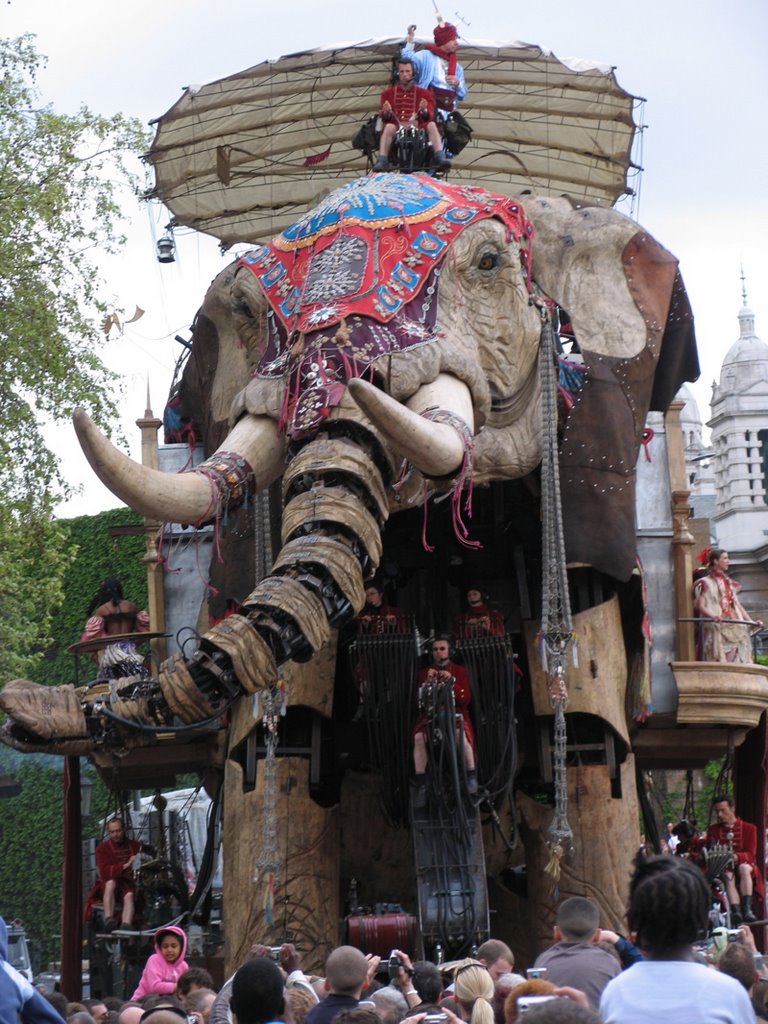
By chance I ran into this last weekend in London. Never quite found out what the point was.
What kind of package would you like for your milk?

The Danish organic dairy producer Thise Mælk is currently using their milk cartons to ask consumers whether they would like a screw top on the milk cartons in the future. Very nice touch. I have no doubt that it provides genuinely useful information for Thise - while at the same time I, as a consumer, get a sense that they actually care and try to produce in a way that I prefer.
You vote by going to their website, of course. I voted no.

Tuesday, May 02, 2006
Elements of the web 2.0-sphere
In his speech at Emerging tech 06 (blogged below) Bruce Sterling gives a good wrap up of some of the elements of the web 2.0-sphere (at about 34 minutes into the speech):
- Un-intended use
- user contribution
- effortless scaleability
- radical decentralization
- costumer self service
- mass service of micromarkets
- software as a service
- right to remix
- architected participation
- Un-intended use
- user contribution
- effortless scaleability
- radical decentralization
- costumer self service
- mass service of micromarkets
- software as a service
- right to remix
- architected participation
Spimes?
IT-conversation just posted a good speech by Bruce Sterling, recorded at Emerging Tech 2006. The title is ”The internet of things”. As usual Sterling is deeper than he appears to be.
In his speech Sterling outlines 6 qualities of a future ”internet of things”:
1. With interactive chips, objects can be labelled with unique identeties, electronically bar-coded, using RFID, a tag that you can mark, rank, sort and shuffle.
2. With local and precise positioning systems, geolocative systems which work out where you are and where things are.
3. With powerful search engines, autogoogling objects.
4. With cradle to cradle recycling, sustainability, transparent production, sorting and shuffling of garbage
5. 3d virtual models of things, virtual design, cad and cam, having objects present as virtualities in the network before they become physical objects 6. Rapid prototyping of objects, fabjects, the ability to digitally manufacture real world things directly or almost directly from their virtual plans
And Sterling proceeds:
Now, if objects in the future had these 6 qualities people would interact with objects in an un-precedented way. It will be so strange and different that we could think about it better if this class of objects had its own name. So I call an object like that a ”spime”. Because an object like that is traceable in space and time
Spimes are manufactured objects whose informational support is so extensive and rich that they are regarded as material instantiations of an immaterial system. Spimes begin and end as data, they are virtual objects first and actual objects second.
So we can engage with these objects better during their entire life cycle. From their moment of invention to their decay.
Sterling also adds that spimes are things which are plannable, trackable, findable, recyclable, uniquely identified and that generate histories.
End of quote.
Personally, I don’t like the word ”spime”, if just for the tone of it. But I’m not sure either that this particular definition is the best way to encircle and categorize a set of developments that I DO believe is significant, and which Sterling summarizes brilliantly.
A illuminating excercise is to try imagine what the objects of the industry you happen to be in would be like, if fitted with those 6 qualities. Very different!
In his speech Sterling outlines 6 qualities of a future ”internet of things”:
1. With interactive chips, objects can be labelled with unique identeties, electronically bar-coded, using RFID, a tag that you can mark, rank, sort and shuffle.
2. With local and precise positioning systems, geolocative systems which work out where you are and where things are.
3. With powerful search engines, autogoogling objects.
4. With cradle to cradle recycling, sustainability, transparent production, sorting and shuffling of garbage
5. 3d virtual models of things, virtual design, cad and cam, having objects present as virtualities in the network before they become physical objects 6. Rapid prototyping of objects, fabjects, the ability to digitally manufacture real world things directly or almost directly from their virtual plans
And Sterling proceeds:
Now, if objects in the future had these 6 qualities people would interact with objects in an un-precedented way. It will be so strange and different that we could think about it better if this class of objects had its own name. So I call an object like that a ”spime”. Because an object like that is traceable in space and time
Spimes are manufactured objects whose informational support is so extensive and rich that they are regarded as material instantiations of an immaterial system. Spimes begin and end as data, they are virtual objects first and actual objects second.
So we can engage with these objects better during their entire life cycle. From their moment of invention to their decay.
Sterling also adds that spimes are things which are plannable, trackable, findable, recyclable, uniquely identified and that generate histories.
End of quote.
Personally, I don’t like the word ”spime”, if just for the tone of it. But I’m not sure either that this particular definition is the best way to encircle and categorize a set of developments that I DO believe is significant, and which Sterling summarizes brilliantly.
A illuminating excercise is to try imagine what the objects of the industry you happen to be in would be like, if fitted with those 6 qualities. Very different!
Singularity summit at Stanford
Uh, I wish I could go to the singularity summit at Stanford may 13th. Looks like it will be a mind blowing day. It's even free - if you're in the neighborhood, of course. One can only hope that they podcast it.
The website has lots of good stuff and references for anyone who's interested in the singularity discussion
The website has lots of good stuff and references for anyone who's interested in the singularity discussion
Wednesday, April 26, 2006
The poetry of everyday life

Yes truly, only Danes can appreciate the poetic beauty of this sign. ...”Tørne hårdt mod bolværket”... Wow.
Tuesday, April 25, 2006
A two-way argument for in-equality
An annual survey of Danish business paper Børsen shows that, once again, executive pay has risen many times faster than salaries for the rest of us. Some expert explained on the radio that the increasing gap in income is justified because of the increasing globalization. If we want to attract and keep the talent, Danish executives should be compensated at the level they could achieve outside of this egalitarian little place.
Interestingly, more or less the same argument is used to justify keeping salaries low for the non-executive workforce; increasing globalization means that workers from Denmark are in direct competition with workers in countries with much lower wages and benefits.
Both arguments are probably right. But it does make me a bit uneasy looking at a world with an increasing gap between the have-nots and the have-a-whole-lot.
Interestingly, more or less the same argument is used to justify keeping salaries low for the non-executive workforce; increasing globalization means that workers from Denmark are in direct competition with workers in countries with much lower wages and benefits.
Both arguments are probably right. But it does make me a bit uneasy looking at a world with an increasing gap between the have-nots and the have-a-whole-lot.
Thursday, April 20, 2006
What makes information valuable
Traditionally, information in media has had value by virtue (among other factors) of being news, being true, relevant and objective.
Increasingly, a number of additional factors determine the value of an item in the media. So here’s a list I’m working on:
For information to be valueable and useful it should be:
-Modular. Easy to break up into smaller nuggets.
-Easy to pass on and recombine
-In a standardized format
-Open code – with permission and the possibility to remix
-Receptive to tags and meta data
-With a community around it
Obviously, this suggests that journalists must learn to rethink the way they format what they produce.
Increasingly, a number of additional factors determine the value of an item in the media. So here’s a list I’m working on:
For information to be valueable and useful it should be:
-Modular. Easy to break up into smaller nuggets.
-Easy to pass on and recombine
-In a standardized format
-Open code – with permission and the possibility to remix
-Receptive to tags and meta data
-With a community around it
Obviously, this suggests that journalists must learn to rethink the way they format what they produce.
Wednesday, April 12, 2006
Schizophrenic times
It seems there are at least a couple of full size realities out there – somehow racing towards each other at accellerating speeds.
One of them is the comfort in which I’m writing this. My home, my great computer, a cup of fresh tea, the cozy comfort, wealth and safety that I can marvel at in gratitude.
Some of the other realities are quite familiar but at an entirely abstract level – for instance the madness and sadness of the Mid-east, the climate change, the usual list...
But frankly, I have no practical interactions with the issue, it’s all media.
Personally, I’ve never been richer, I’ve never had so many possibilities, I’ve never been more comfortable. It's a time of progress – and I have a sense that I share this with many others.
And yet, so much of the media horizont tells me the world is going to hell – and it may very well be the case.
So, I’m sitting here as a spectator, just watching. Wondering when I will be entangled – for real – in those other realities. What will it be like?
One of them is the comfort in which I’m writing this. My home, my great computer, a cup of fresh tea, the cozy comfort, wealth and safety that I can marvel at in gratitude.
Some of the other realities are quite familiar but at an entirely abstract level – for instance the madness and sadness of the Mid-east, the climate change, the usual list...
But frankly, I have no practical interactions with the issue, it’s all media.
Personally, I’ve never been richer, I’ve never had so many possibilities, I’ve never been more comfortable. It's a time of progress – and I have a sense that I share this with many others.
And yet, so much of the media horizont tells me the world is going to hell – and it may very well be the case.
So, I’m sitting here as a spectator, just watching. Wondering when I will be entangled – for real – in those other realities. What will it be like?
Tuesday, April 04, 2006
Sony drops robo-pets

For some reason this has slipped under my radar till now, but:
Sony has decided to discontinue their robotic efforts, which means that they no longer will produce Aibo and they will stop developing their humanoid luxury robot Qrio.
You can see the announcement here.
I must say I was pretty impressed with Aibo and Qrio. Watching them move around you get this strange feeling that there is something in there - a third kind of being; not just mechanical, not quite alive.
I never felt tempted to actually get one, I wouldn't know what to do with it. On the other hand, I'm surprised that Sony is pulling out. Whether it will be as robo-pet, security robots or whatever, I still believe robotics will be a growing market.
Subscribe to:
Posts (Atom)