Saturday, July 29, 2006

TV crap

Sorry to drone on about energy, but:
Just happened to see this ridiculous TV ad for the Hummer.

It starts out with a healthy, green-clad young man in a supermarket checkout, buying tofu and other deplorably bland, veggie stuff.


Right after him comes another guy who gets loads of meat, a bottle of alcohol and other tempting goodies. Our young green protagonist grows VERY frustrated.


So he runs out and buys himself a hummer. Yeah! So finally he can eat a carrot with a smile. The caption reads: Restore the balance.


And of course it all ends with the Hummer logo over a shot of mother earth seen from space.


Wow! I guess I should start saving up for one too.

Sleepless in Toronto


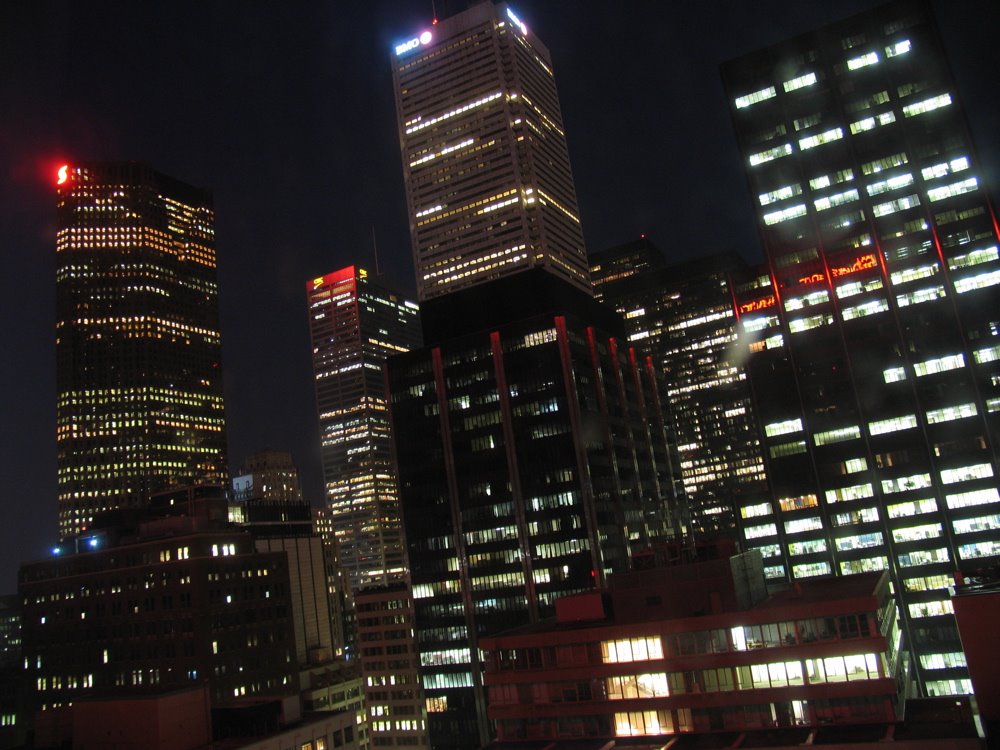
5 AM saturday morning, the view from my window is a wall of offices, almost half of them have the lights left on for the night – and in this case, the entire weekend. No sign of anyone working in any of those many rooms.
Canada seems as determined to waste energy as anyone else. At least, you can take comfort in the realization that there are plenty of easy ways to reduce the energy-load considerably. Just turn the light off when you leave.

The future is un-predictable

I’m at the world future society’s annual meeting – this year in Toronto. And boy, does the future ever look un-predictable. Seems we’re going in many different, mutually exclusive, directions at once.
Just to name a few: Turning back the burning of fossil fuels to anything near sustainable levels looks rather unfeasible on a 30 – 50 year timescale – So, we’re cooking the planet, with a lot of ensuing suffering in all kinds of ways.
Or: Will nano and bio-tech combined instead lift us out of the mess, make us capable of creating anything we like at low cost, solve the energy crisis, make everything recyclable, and change us into a new species of super-smart cyborgs in the process – in pretty much those same 30 – 50 years. Or less.

Wednesday, July 12, 2006

Major mindless damage

The Herald tribune has this amazing article about how wasteful the Russian energy production and distribution is.

In the article the director of the International Energy Agency, Claude Mandil, specifically critizes the widespread practice of gas flaring - that is, burning off gas at oil wells.

"Between 40 billion cubic meters and 60 billion cubic meters a year are being burned in Russia," he said. "That is about a quarter of the 200 billion cubic meters of gas Russia exports to Europe a year."

According to the World Bank, each year about 150 billion cubic meters of natural gas is flared off - equivalent to 30 percent of the European Union's gas consumption.

Developing countries account for more than 85 percent of gas flaring and venting, including Nigeria, Russia, Iran, Iraq, Angola and Qatar.

In Russia, "gas flaring exists because today Gazprom is the only one that can buy this gas," Mandil said. "It buys this gas at such a low price that producers do not see the reason to build a small pipeline that could bring this gas from the field to the trunk line."

So much for avoiding the greenhouse effect...

Friday, June 09, 2006

Snapshots from the future


I have a new book out!
It’s called Snapshots from the future, and it’s 7 short stories that describe life in about 25 years time – give or take a decade.

The book is published in Danish, but the text has been translated into English and the whole thing is posted at the website of Danfoss Universe.

For years I’ve wanted to create something like a cartoon, with a heavy emphasis on pictures and a narrative form to engage readers more emotionally. I’ve tried to keep light and inviting – but the underlying facts are never the less a quite serious attempt to destill years of future studies into a coherent picture.
It can be read by kids at about 15 years, but it’s not meant to be just for school. I would hope that anyone trying to make sense of the future could find some inspiration in it.

For me, the book has turned out pretty much exactly how I wished it – which is very satisfying, of course. The project has been a lot of fun. My old friend and colleague Henrik Føhns made it happen by agreeing to print the articles in the Danish magazine Samvirke – and by suggesting the book project in the first place (tak for det, Føhns!). Emil Landgreen has created some great and beautiful illustrations and fake advertisements.
So have a look – and let me know what you think.

Oh, and for Danes who want to buy the printed version:
FDBs Skolekontakt sells them, either 59 kr. for a copy or 350 kr. for a set of 30 copies.

Tuesday, May 23, 2006

Go ahead, emit!

Wow, this is seriously weird. Some organisation called "Competetive enterprise Institute" (sponsored by Exxon-mobil among others) has produced two very slick TV-ads that promote CO2. We call it life, they say. Check 'em out, you need to see this.

Monday, May 22, 2006

GE Ecomagination publishes first annual report


GE has just published a report/36 page advertising that describes the first year of their Ecomagination initiativ. It’s not perfect, some may think it’s mostly greenwash, but I happen to be impressed. It’s a very big company and taking it through this kind of re-orientation can not be easy. It’s an audacious undertaking, and it has real impact. Respect!

From the report:

Specifically, GE has pledged to:
Double its investment in clean R&D—GE is growing
its research in cleaner technologies from $700 million
in 2005 to $1.5 billion in 2010.
Increase revenues from ecomagination products—
GE will grow revenues from products and services that
provide significant and measurable environmental performance
advantages to customers—to at least $20 billion
in 2010, with more aggressive targets thereafter.
Reduce its greenhouse gas (GHG) emissions and improve
the energy efficiency of its operations—GE is committed to
reduce its GHG emissions 1% by 2012, reduce the intensity
of its GHG emissions 30% by 2008, and improve energy
efficiency 30% by the end of 2012 (all compared to 2004.)
Without this action, GHG emissions were predicted to rise
substantially by 2012, based on GE’s projected growth.
Keep the public informed—This report is just one way GE
will publicly report its progress in meeting these goals.

What’s so inconvenient about climate change?

Attempting to reduce climate change demands us to change our lifestyle at a very basic level. In one sense it represents a reversal of a development that has been a main characteristic of humanity.
The story of human development is intimately linked to our increasing power and freedom to connect and move around over ever larger distances.
With the technology that is likely to be available in the foreseeable future, avoiding climate change by reducing CO2 emissions, will require us to reverse that. So: Less jetting and driving around, less long distance trade, less freedom to choose whatever we want anywhere and anytime.

There are a lot of very good reasons to wish that we can continue towards higher connectivity, a cosmopolitan society, more comfort. It’s a big part of desires of modern man and woman: this slick world where humans get what we want - now.
Giving it up is not only inconvenient - somehow it feels like crawling backwards in the evolutionary tree.

Saturday, May 20, 2006

SAS Airlines offers emission calculator


You can't really say you don't know. SAS has created a web-service so passengers can see the emissions that the flight they are booking will cause.
Great idea, although it's very well hidden if you are accessing their website from the frontpage. I only found it because I had been given the direct link.

Al Gore on global warming


The trailer for "The incovenient truth", a new film with Al Gore presenting the scary low-down on climate change is out, as well as an extensive website with scientific facts, a calculator to see just how much damage you're doing, and the inevitable blog.
Judging from the trailer, it looks like a very powerful piece of argumentation - the Hollywood drama and bombastic music is not quite to my liking, but I have a sense that this might be what it takes to really get the message out.
It's a terrible situation we're facing - but at last it looks like the issue will emerge from denial. Next step is some action, but, uh, that's the hard part. Very inconvenient, indeed.

Monday, May 15, 2006

Heatwave in dense environment


They've had a heatwave in India and Pakistan this weekend, with temperature reaching 49 degrees celcius in some places. Not very comfortable we can assume.

Saturday, May 13, 2006

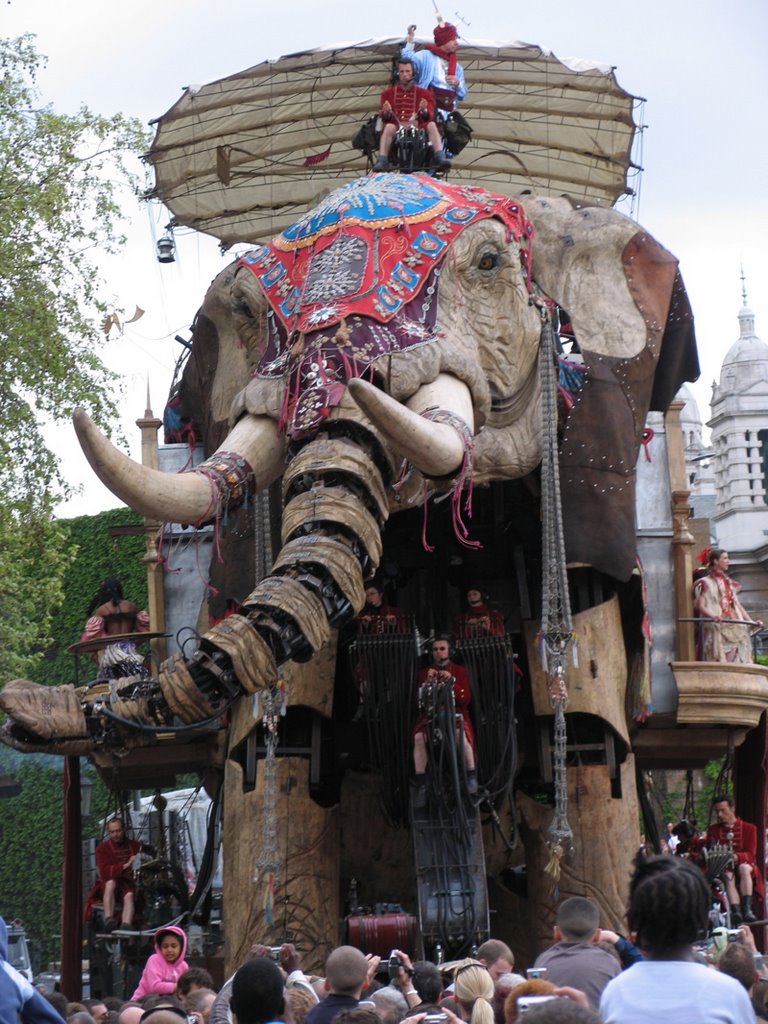
Big elephant in London


By chance I ran into this last weekend in London. Never quite found out what the point was.

What kind of package would you like for your milk?


The Danish organic dairy producer Thise Mælk is currently using their milk cartons to ask consumers whether they would like a screw top on the milk cartons in the future. Very nice touch. I have no doubt that it provides genuinely useful information for Thise - while at the same time I, as a consumer, get a sense that they actually care and try to produce in a way that I prefer.
You vote by going to their website, of course. I voted no.

fiberoptics plus photoshop

Tuesday, May 02, 2006

Elements of the web 2.0-sphere

In his speech at Emerging tech 06 (blogged below) Bruce Sterling gives a good wrap up of some of the elements of the web 2.0-sphere (at about 34 minutes into the speech):

- Un-intended use
- user contribution
- effortless scaleability
- radical decentralization
- costumer self service
- mass service of micromarkets
- software as a service
- right to remix
- architected participation

Spimes?

IT-conversation just posted a good speech by Bruce Sterling, recorded at Emerging Tech 2006. The title is ”The internet of things”. As usual Sterling is deeper than he appears to be.

In his speech Sterling outlines 6 qualities of a future ”internet of things”:
1. With interactive chips, objects can be labelled with unique identeties, electronically bar-coded, using RFID, a tag that you can mark, rank, sort and shuffle.
2. With local and precise positioning systems, geolocative systems which work out where you are and where things are.
3. With powerful search engines, autogoogling objects.
4. With cradle to cradle recycling, sustainability, transparent production, sorting and shuffling of garbage
5. 3d virtual models of things, virtual design, cad and cam, having objects present as virtualities in the network before they become physical objects 6. Rapid prototyping of objects, fabjects, the ability to digitally manufacture real world things directly or almost directly from their virtual plans

And Sterling proceeds:
Now, if objects in the future had these 6 qualities people would interact with objects in an un-precedented way. It will be so strange and different that we could think about it better if this class of objects had its own name. So I call an object like that a ”spime”. Because an object like that is traceable in space and time

Spimes are manufactured objects whose informational support is so extensive and rich that they are regarded as material instantiations of an immaterial system. Spimes begin and end as data, they are virtual objects first and actual objects second.
So we can engage with these objects better during their entire life cycle. From their moment of invention to their decay.

Sterling also adds that spimes are things which are plannable, trackable, findable, recyclable, uniquely identified and that generate histories.

End of quote.
Personally, I don’t like the word ”spime”, if just for the tone of it. But I’m not sure either that this particular definition is the best way to encircle and categorize a set of developments that I DO believe is significant, and which Sterling summarizes brilliantly.
A illuminating excercise is to try imagine what the objects of the industry you happen to be in would be like, if fitted with those 6 qualities. Very different!

Singularity summit at Stanford

Uh, I wish I could go to the singularity summit at Stanford may 13th. Looks like it will be a mind blowing day. It's even free - if you're in the neighborhood, of course. One can only hope that they podcast it.
The website has lots of good stuff and references for anyone who's interested in the singularity discussion

Wednesday, April 26, 2006

The poetry of everyday life


Yes truly, only Danes can appreciate the poetic beauty of this sign. ...”Tørne hårdt mod bolværket”... Wow.

Tuesday, April 25, 2006

A two-way argument for in-equality

An annual survey of Danish business paper Børsen shows that, once again, executive pay has risen many times faster than salaries for the rest of us. Some expert explained on the radio that the increasing gap in income is justified because of the increasing globalization. If we want to attract and keep the talent, Danish executives should be compensated at the level they could achieve outside of this egalitarian little place.

Interestingly, more or less the same argument is used to justify keeping salaries low for the non-executive workforce; increasing globalization means that workers from Denmark are in direct competition with workers in countries with much lower wages and benefits.

Both arguments are probably right. But it does make me a bit uneasy looking at a world with an increasing gap between the have-nots and the have-a-whole-lot.

Thursday, April 20, 2006

What makes information valuable

Traditionally, information in media has had value by virtue (among other factors) of being news, being true, relevant and objective.
Increasingly, a number of additional factors determine the value of an item in the media. So here’s a list I’m working on:

For information to be valueable and useful it should be:
-Modular. Easy to break up into smaller nuggets.
-Easy to pass on and recombine
-In a standardized format
-Open code – with permission and the possibility to remix
-Receptive to tags and meta data
-With a community around it

Obviously, this suggests that journalists must learn to rethink the way they format what they produce.

Wednesday, April 12, 2006

Schizophrenic times

It seems there are at least a couple of full size realities out there – somehow racing towards each other at accellerating speeds.
One of them is the comfort in which I’m writing this. My home, my great computer, a cup of fresh tea, the cozy comfort, wealth and safety that I can marvel at in gratitude.
Some of the other realities are quite familiar but at an entirely abstract level – for instance the madness and sadness of the Mid-east, the climate change, the usual list...
But frankly, I have no practical interactions with the issue, it’s all media.
Personally, I’ve never been richer, I’ve never had so many possibilities, I’ve never been more comfortable. It's a time of progress – and I have a sense that I share this with many others.
And yet, so much of the media horizont tells me the world is going to hell – and it may very well be the case.
So, I’m sitting here as a spectator, just watching. Wondering when I will be entangled – for real – in those other realities. What will it be like?

Tuesday, April 04, 2006

Sony drops robo-pets


For some reason this has slipped under my radar till now, but:
Sony has decided to discontinue their robotic efforts, which means that they no longer will produce Aibo and they will stop developing their humanoid luxury robot Qrio.
You can see the announcement here.
I must say I was pretty impressed with Aibo and Qrio. Watching them move around you get this strange feeling that there is something in there - a third kind of being; not just mechanical, not quite alive.
I never felt tempted to actually get one, I wouldn't know what to do with it. On the other hand, I'm surprised that Sony is pulling out. Whether it will be as robo-pet, security robots or whatever, I still believe robotics will be a growing market.

Monday, February 20, 2006

Better late than never - google earth for mac


This is hardly news, but it had escaped my till now. Google earth is now available for mac! Uhhh, it's so cool. Get it here.
Now, would somebody please make a better resolution shot of my home.

Thursday, February 16, 2006

From transaction to interaction

I noticed this little nugget of wisdom in a podcast from Davos with Cisco CEO John Chambers: He says we're moving from transaction to interaction.
It's the old "markets are conversations" riff - and increasingly true.

Friday, February 10, 2006

Mobility madness


Seems I’m always moving from one place to another, stuck on the road.
Survival strategy; just don’t think about it.

Saturday, January 28, 2006

Good food in the big apple

Two good restaurants that I have tried several times over the years with great delight. High quality, personality, reasonable prices, lots of people:

For Sushi:
Hasaki, 210 east 9th. st.
Right by skt. Marks square

For Mexican:
La Palapa Rockola, 359 sixth ave.
Between Washington place and west 4th. st.

Thursday, January 26, 2006

Democratic dilemma

So, now that Hamas has been voted into power in Palestine, president Bush faces the same dilemma that many of us feel about him: We believe in democracy, but we sometimes feel extremely uncomfortable with those that get elected.

Podcasts. from Davos


Just in case you can't get your helicopter started to go in person, most of the sessions are being podcast - here's the menu to choose from.

Saturday, January 21, 2006

What makes information valuable?

A few more thoughts on Apple I-life 06.
To me it’s significant because it brings us further ina development that is changing the media and the ways in which we use it. The tools we use for the most part to produce media where developed according to a paradigm where information was mainly something you created and transmitted – or you recieved and consumed it. It was a step by step process, mostly one way.
But a tool like I-life 06 reflects and promotes a differenct paradigm. It takes it for granted and it encourages you to use media in a new way.
You know:
Where Information is created and exchanged as a conversation with a potentially very large network of participants – rather than producers and consumers.
Where each information unit is treated as a component that can be reused, changed, combined with other units, tagged, commented, linked.
So, information is flow, information is under development, information is participatory.

As our tools are changed to fit this paradigm, I think we will start to think differently about what makes information valuable. New qualities will become important, such as:
- open code
- easy to pass on and recombine
- standardized format
- receptive to tags and meta data
- with a community around it

And, it seems that very similar considerations will apply to every business and realm where digital technology is a dominant part of the value creation.

Reise Reise


Copenhagen airport is out due to the snow storm. So I'm stuck in Vienna.

Meme watching


The meme of folding the toilet tissue roll at hotels has spread world wide. Now it seems to have mutated. At the Landgraf hotel in Linz, Austria, the triangular flap has now been enhanced with a cute stamp – ”cosy” it says.

Friday, January 13, 2006

The means to build and access the global brain

No, it’s not just a fancy metaphore. We are building a global brain, connecting the neurons by our collective efforts to put knowledge online, connecting sensors to the net, tagging, aggregating, commenting, linking, concluding...
We’ve been at it for a long time. Maybe it started with the passing of knowledge and stories between generations, it gained speed with the ability to draw and write to store and transmit information, - and you the rest: Things are accellerating, with more connections, better tools.

And it’s real. Real knowledge, real inventions, valuable insights emerge as people connect the dots and exchange information.
It’s almost banal, but we are collectively enhancing our cognitive abilties through our increasing participation in this emerging global organism.

Much has been said about using genetics and nanotech to enhance humans, but in fact we’re doing it all the time. Our cognitive and sensory abilities are very directly related to the degree to which we use information technology. And we’ve long since passed the point where we could do without it.

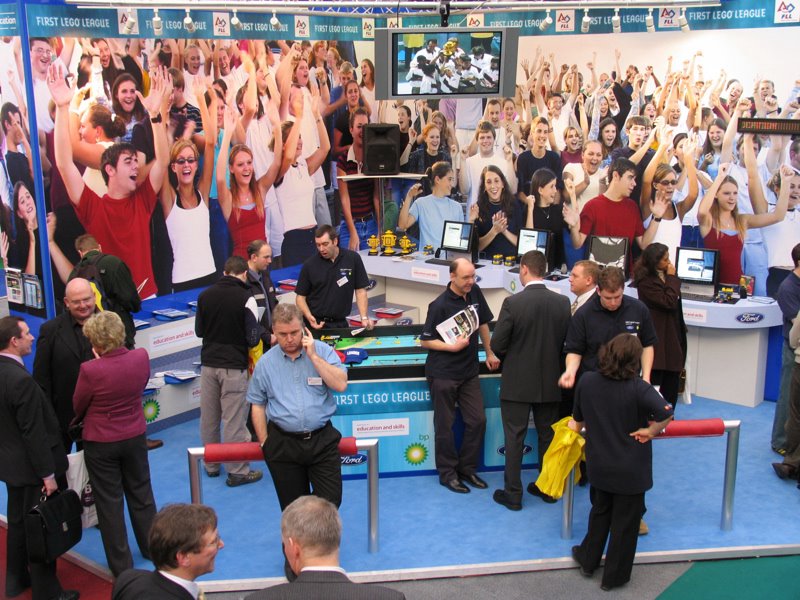
The BETT show, supposedly the worlds largest show on IT and education. I can testify; it IS big. The usual tradeshow madness, this one takes place at Londons olympia hall.
It’s a weird experience: it’s the place where all the teachers that are computer literate and really try to push the envelope, and it’s completely packed with companies that develop educational solutions that use computers in all kinds of clever ways. So it’s like, computers are a natural tool in classrooms, and kids can benefit tremendously from using their laptops, mobile phones, blogs, game consols etc. as an integrated part of learning.
And yes, I totally believe in that. But the BETT show is like a parallel reality. We all get it here. But if you look at the reality of the school that my kids attend it’s a very different story – a story where classrooms and the way kids learn is pretty much the same as when I was a child - way back in the industral society.
A few findings:
- Smartboard, the leading manufacturer of .. well, smart boards, told that they have sold 375.000 boards worldwide so far – 125.000 of those in the UK.

But first of all, Apple was showing i-life 06. To me it’s a work of genius. It’s a pleasure to sense the intellect behind it. The integration of podcasting/RSS subscription and the continued seamless and totally, wonderfully easy integration of all media... it’s exactly what we’ve hoped for, but haven’t quite seen.
A lot has been written about the transition to Intel processors, and, yes, it adds speed and probably decreases incompatability, but to me the really significant part is the vision of the new i-life. It takes Apple to a new level, way ahead of the pack.
More on this later. Gotta get some sleep.

Thursday, January 12, 2006

LSE - gotta go


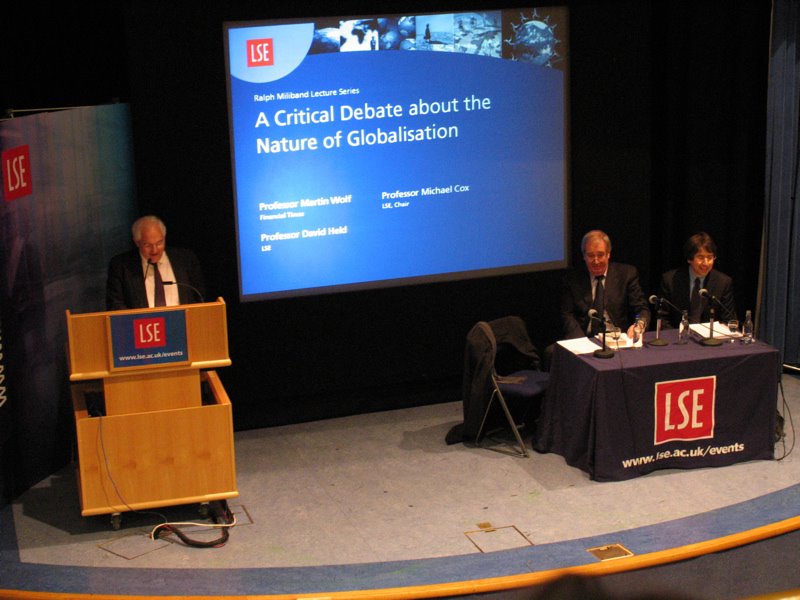
When in London I always check out the events program at LSE, the London School of Economics. Some of the talks there are amazing, the most powerful people and the best minds of the planet presenting in a civilized academic atmosphere in the delightfully old-fashioned Hong Kong Theatre. Tonight it was Martin Wolf, editor and commentator at Financial Times, and LSEs own David Held discussing the consequences of globalization.
Wolf, the liberalist, argued that markets will determine pretty much everything.
Held, describing himself as a ”cosmopolitan social democrat, argued that we still need ideology. He feels that we can influence where the world is heading by insisting on certain universal values, such as human rights, social justice and environmental protection.
I’m on David Helds side.

Let me highlight two upcoming LSE events:
On february 15th Ulrich Beck will speak on ”Living in the world risk society”, and on march 16th. Richard Dawkins, Dan Dennett and Matt Ridley will discuss Dawkins book ”the selfish gene” on the 30th anniversary of its publishing.
... And there’s so much more. All free, I should add. A treat!

Anywhere, anytime, but it happens to be London


Yeah, I spend a lot of time in hotels...

Sunday, January 08, 2006

Ugly dog

Ah, Photoshop - such fun to mess around with. Any number of exotic flowers cannot disguise the fleas and scabs.

Tuesday, January 03, 2006

Energy too cheap to meter

I’ve been reading up on energy policy lately – it’s important stuff. One piece that really sticks out is Peter Schwartz’ glowing presentation of ”How clean, green atomic energy can stop global warming” in Wired Magazine some months back.
There’s something very attractive about the spirit of optimism and the drive towards a bigger, better future that Peter Schwartz and GBN a
argues so compellingly for in his papers – like the ”Long boom” vision back in the pre-dot.com crash days.
There’s a very important component in Schwartz’ article: it offers a vision that you want to believe in and pursue. Try to read the final paragraph of his article:

” The more seriously you take the idea of global warming, the more seriously you have to take nuclear power. Clean coal, solar-powered roof tiles, wind farms in North Dakota - they're all pie in the emissions-free sky. Sure, give them a shot. But zero-carbon reactors are here and now. We know we can build them. Their price tag is no mystery. They fit into the existing electric grid without a hitch. Flannel-shirted environmentalists who fight these realities run the risk of ending up with as much soot on their hands as the slickest coal-mining CEO.

America's voracious energy appetite doesn't have to be a bug - it can be a feature. Shanghai, Seoul, and São Paolo are more likely to look to Los Angeles or Houston as a model than to some solar-powered idyll. […]

Nuclear energy is the big bang still reverberating. It's the power to light a city in a lump the size of a soda can. Peter Huber and Mark Mills have written an iconoclastic new book on energy, The Bottomless Well. They see nuclear power as merely the latest in a series of technologies that will gradually eliminate our need to carve up huge swaths of the planet. "Energy isn't the problem. Energy is the solution," they write. "Energy begets more energy. The more of it we capture and put to use, the more readily we will capture still more."

Wouldn’t it be wonderful! The way I read it, these sentences argue that energy consumption is at the heart of our civilization. The more energy we consume, the more powerful, comfortable and generally highly developed we become. We should harness and use energy freely, apply it in abundance to amplify our power and continued progress from primitive being to some yet unknown ever-evolving superior state of humanity.
We’re just not going to get off the ground unless we exploit the ressources around us.

In a way I agree. We’ve gotta move forward, and I enjoy a nice warm house, jet travel and global consumer choices as much as anyone. Energy is the key to all of this.

Here’s another quote:
”Wouldn't it be a blast to barrel down the freeway in a hydrogen Hummer with a clean conscience as your copilot? Or not to feel like a planet killer every time you flick on the A/C? That's how the future could be, if only we would get over our fear of the nuclear bogeyman and forge ahead - for real this time - into the atomic age.

If only our energy consumption didn’t wreck the biosphere. If only nuclear energy really were as un-problematic as Peter Schwartz argues that it is.
My fear is that there ARE serious hidden costs – and not just in terms of pollution and security, but more fundamentally with the materially focused, get-ahead-culture that his words project.
It’s great to make a splash and deem it progress, but if it leaves everybody else worse off, and in fact corrodes our common basis of existence, maybe it would be better to focus less on transcending the human condition and fullfiling consumer fantasies – and concentrate more on simply keeping our civilization going through what could be a very severe situation.

You can’t save your way to grandeur. Maybe we need to ”forge ahead into the atomic age” in order not to be swamped by the problems we have created on our way to here. But then again, maybe there’s a more nuanced way of proceeding: acknowledging that there’s more to life than barreling down the freeways; some values that are not as dependent on massive injections of energy.

Yes, I’m split, confused, scared and tempted.

... a final comment: To some extent we all have our opinions shaped by who’s paying the bill. Reading his articles in Wired magazine one should be aware that this is not written a journalist. I can’t help wonder who Peter Schwartz’ clients are – a little disclosure would make it easier to asses the paper.

Tuesday, December 20, 2005

Complexity theory as a basic litteracy

Another realization from our future learning environment project:
The Danish school system is built on 5 basic ”litteracies” – the fundamental skills you need in order to keep learning and to function in a modern society. The 5 litteracies are: reading, writing, math, being able to use information technology and English as a second language.

Obviously, what skills should be considered basic litteracies changes as society develops. So is there some new skill that will be indespensable in the future? Well, yes.
As everybody and everything are increasingly becoming connected in global, ubiquitous, high-density, always on networks we need to understand how complex dynamic systems work. You know: the internet, the market place, ecology, politics… complex systems are everywhere.

There’s a “package” of mechanisms that are common to all aspects of complex systems. They are all inter-connected and I don’t quite know what the overall title to the package should be. But among the contents are:
- - Feedback, non-linearity
- - The emergence of natural patterns such as fractals and hexagons
- - The same patterns occuring on all scales – from atomic to galactic
- - Evolution, genetics
- - Complex behaviours emerge in the interaction between many very simple functions
- - Small changes in initial conditions can have great consequences
- - Diversity makes a system more robust
- - You are dealing with probability rather than certainty

These are crucial insights – and I believe they will become even more so in the future. In many ways they run completely counter to the linear, top-down, predictable logic that formed the basis of industrial society.
I would argue that an understanding of this package of mechanisms will be a basic litteracy – if it isn’t already. But it’s not taught in a systematic way today. It doesn’t fit into one particular subject, and the concepts seem too abstract to communicate to children.

In fact I think there are lots of ways to teach and learn about complexity that are tangible, grounded in everyday life, and intuitively easy. One example that doesn’t quite get there is LEGO Mindstorms. I sense that it can be made easier still – hopefully, we can demonstrate that within a couple of years.

Learning - forget about subjects

At Danfoss Universe we’re coordinating a research project trying to create a learning environment for the future. Great project, good people on board and lots of enlightning discussions.
Here's one observation from there:
In a traditional school subjects are kept separate. The schedule shows it clearly: math, language, biology, history, physics etc. But this kind of compartmentalization is probably somewhat counter productive.
In many cases it would make more sense organizing learning around a different structure.
An example would be to use a narrative as a starting point, weaving aspects of many different subjects into the project.
Starting with the narrative makes it much easier to engage the learner through the usual narrative elements that drive a story forward. It also makes it easier to show how things are connected, and how what you learn can be applied in some situation.
If you have kids you have probably observed how engaged they become when the regular schedule is abandoned for a week or so to work on a particular theme or project.
Cross disciplinary projects, with elements of a narrative, connecting to everyday experiences and observations, demanding the learner to explore, structure, build and present – it makes sense not just for pedagogical purposes, but also because it is a reflection of what reality is actually like. These are the skills we will need – rather than merely reproducing what you are being told in a one-way transfer of facts from teacher to student.

Friday, December 09, 2005

Details with a difference


Several people (no, not from Denmark) have told me how the integration of an ipod with the stereo system was a major factor when they choose their new, expensive car. Amazing how a $250 gadget can determine the purchase of product that's a hundred time more expensive.
The trendwatching site Übercool has collected some good examples of how some car manufacturers have started to adress this in this article.

Big Brilliant Weirdness


More video: The Carlton draught ad which is running in Australia is soo meta. Good fun, big budget. Big ad!

Sunday, November 20, 2005

Home improvement


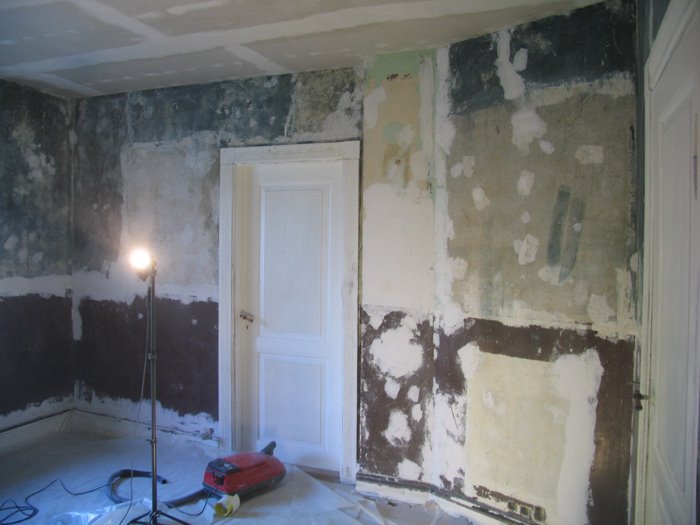
The situation here in Troense. Green dust is everywhere. We're working on it.

Friday, November 18, 2005

The place to sleep in Copenhagen

I have previously blogged about how much I like staying at hotel Guldsmeden in Århus. They have a hotel in Copenhagen as well and I can now report that it is just as great. Good atmosphere, nice furniture, free wifi, best breakfeast I can remember offhand. Reasonable prices too.

Appearantly the Guldsmeden folks are going upscale next. They are renovating another Copenhagen hotel, it will be a 4 star joint, with a cafe. If I get the chance to stay there, I shall report.


Olafur Eliassons "Light Setup"


If you are anywhere near the Swedish cities Malmø or Lund I can recommend taking a look at Olafur Eliassons twin exhibitions at the municipal art spaces of those two cities. The title is ”the light setup”.

The show in Lund is a collection of around hundred works, more or less finished, each an experiment testing some idea, an effect, a shape, an optical illusion. At first it looks it looks pretty messy, like a peek into someone’s workshop, but once you get into it, great depths of beauty reveal themselves.

The way I see it, Eliasson doesn’t really create art himself. Rather, he creates mechanisms and spaces where we can stop and discover the art and beauty in natures’ shapes and functions. Waves, spiral, shadows, fractals. Very stimulating.

The other show is very different. All of Malmø kunsthal is just one great space. At one end the whole is turned into a bright, uniform light, with the warmth of the color oscillating slightly from yellowish to more blue. Part of the ceiling is also a big sheet of light. Simple, beautiful. Go see!
Open til january 8th.

Tuesday, November 08, 2005

Clashing paradigms - work in progress

So, I've tried to list the characteristics of these two paradigms that seem to be clashing and changing in strength relative to eachother, un-easily overlapping and co-existing.
I'd be happy to hear any comments or additions.
Sorry about the layout, I can't figure out how to fix it. Just keep scrolling down, it will come.


industrial societyinformation society
Hierarchicalnetworked
top downbottom up
client - serverp2p
zero sumplus sum
screw 'emexplicit interdependence
exclusivitysharing, open source
distinct roles, producer - consumerblurring roles, co-creation
Monopolization of means of productionDistribution of the means of production
high entry barrier to productionlow entry barrier
Broadcastmany to many
centralisationdecentralisation
Authoritywisdom of the crowd
Follow orderscreative thinking
motivation; money, ordersmotivation: fun, recognition
controlanarchy (as Kropotkin defined it)
vision, direction, intentemergent solution
Radically different innovationincremental innovation
Longterm planningAd hoc
mechanical paradigmbiological
exactfuzzy
hard science, predictablesoft science, probabilistic
reductionistholistic, emergence

Flying in the face of reason

Weird, this shouldn’t happen. One of the largest adjustments in the national budget that the government just announced is removing the taxes on airplane trafik, which currently is about 10 euro pr. Flight.
In the news, this was presented as something like a christmas gift to us all; Ah, now we can go fly as we please, unburdened by crunching taxation.
But this is 2005, we’re in the age of rampant global climate change and the end of fossil fuel is near. If anything, I would have expected an attempt to finally put some taxes on jet fuel which at the moment is totally exempt.

We’ve got a fundamental clash of logics happening here:

The prevailing logic: Gotta move faster. Of course, cause everybody else does, too. I understand, I really do.

The logic of reality as I see it to the best of my knowledge:
Air traffic is the fastest growing segment in transportation. Travelling a mile in a plane uses about the same amount of fuel pr. Person as in with cars – but you rarely just get in and fly 1000 km. or more for a meeting or a weekend. Plus, the fumes are released in a more fragile part of the atmosphere making their contribution to the greenhouse effect much worse. Compared to car travel, air traffic is way cheaper because there are no taxes on the fuel.

Meanwhile, DSB – the national Danish railways – are losing thousands of passengers due to perpetual, yet un-predictable major delays because the trains can no longer drive at high speeds on rails that are poorly maintained.

Saturday, November 05, 2005

Good reasons not to act

Looking at the various curves stretching upwards forecasting the rising consumption of natural ressources - the number of people on earth, the concentration of CO2 in the atmosphere, the rising sea level and increasing temperature - it is pretty obvious that we are in for some fundamental changes in the coming decades.The main question seems to be whether it will be a relatively smooth transition or one of collapses and disruptions.
We ought to change our lifestyle and our consumption – but we don’t. To the contrary, it’s an age of expansion, for many of us way beyond what we were able to imagine just recently.

There are good reasons NOT to hold back on consumption. Maybe the most important one is that consumption of ressources is directly related to power. The more energy you use, the more power you have – more or less. If you jet around, if you jump in the car and speed ahead, if you don’t slow down to pick up the garbage, you will have more power. You can get things done, you are a player in a very different way than somebody ”sitting self- righteously at home in a woolen sweater”, as British journalist Mark Lynas puts it.
Changing the world by setting a good example of low consumption and responsible behaviour sounds like the right path, but it’s just not very sexy.
And maybe, maybe it’s simply not the best solution.
Who knows? Maybe the best we can do is to keep jetting around, accellerating life and the economy in the hope that this will quicken the development of some wonderful technical fix that will once again buy us time in the land of mindless, convenient consumption.
It’s weird, though, there’s so much we ought to do, so many solutions that we pretty know would help somewhat, but ironically we’re simply too busy to do anything serious about it.
Engaging ourselves in changing the world will be a very sophisticated sell – or it will be prompted by un-ignorable necessity.

Saturday, October 29, 2005

I wish there was some good news


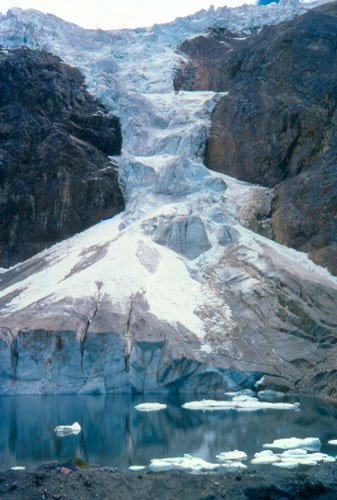
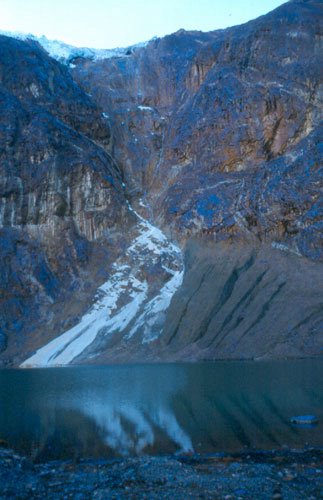
Photos by Mark Lynas, www.marklynas.org


At the Poptech conference last week British journalist Mark Lynas gave one of those presentations that leave you rather depressed.
Global warming is certainly happening, and I keep hoping someone would come up with a bit of good news, like, they've found out that it's not so bad after all. But every time I listen it seems to be getting worse.

Mark Lynas has travelled the globe, documenting the already visible effects of the changing climate. Among other places he went to the Peruvian Andes where his father had worked as a geologist in the 1980ies. He had his dads' old photos from the glaciers there and took new photos in the exact same spots. The upper photo is from 1980, the lower from 2004. Uhh!

A big beautiful whale blowing


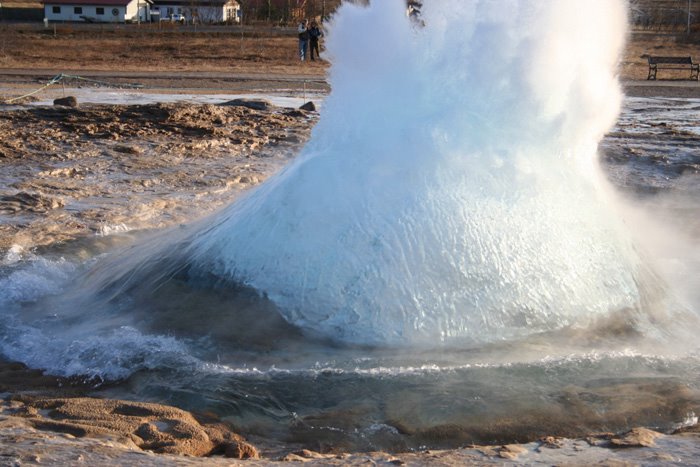
Wonderful, I went to Iceland on business. In the science-park we have an artificial Geysir that erupts 18 meters into the air.
I figured it might be fun to have a live webcam showing the REAL geysir next to ours, as part of our attempts to explain visitors how a geysir works.
So on my way back from Boston I made a stopover and had a great day with my counterpart at the Geysir. Oh Iceland, it’s incredibly beatiful.

The shots here show part of what’s going on; hot and cold meeting in the 40 meter deep hole, pressure building up till suddenly... BOOM!

Then the boiling waters flows back into the hole with a deep sucking sound. You clearly get the sense that the earth is a big, living creature. Rumbling and pumping like a heart beating, drawing air, exhaling, steaming and sweating. Maybe we’re standing on top of a big whale.
Maybe it’s whales all the way down...

Friday, October 28, 2005

Fremtids arkæologi

Sorry, this is just for the Danish speaking:
Jeg har det sidste halve år haft en artikel serie i Samvirke med titlen "fremtids-arkæologi".
Jeg har lagt 6 artikler på mit website, den 7. følger om en måneds tid.

The hands from the trains of Bombay

Suketu Mehta is an indian born journalist who grew up in New York. He went back and spent two and a half years in Bombay – with his wife and two small kids – and he wrote the book ”Maximum city” about this incredible place.
Lots of it seems very depressing, but he offers this beautiful image of why he, despite all the problems, believes that Bombay is a city of the future and how the people living there show a way forward:

”If you are late for work in the morning in Bombay, and you reach the station just as the train is leaving the platform, you can run up to the packed compartments and find many hands stretching out to grab you on board, unfolding outward from the train like petals. As you run alongside the train, you will be picked up and some tiny space will be made for your feet on the edge of the open doorway. The rest is up to you. You will probably have to hang on the door frame with your fingertips, being careful not to lean out too far lest you get decapitated by a pole placed too close to the tracks. But consider what has happened. Your fellow passengers, already packed tighter than cattle are legally allowed to be, their shirts already dreanched in sweat in the badly ventilated compartment , having stood like this for hours, retain an empathy for you, know that you boss might yell at you or cut your pay if you miss this train, and will make space where non exists, to take on more person with them. And at the moment of contact, they do not know if the hand that is reaching for theirs belongs to a Hindu or Muslim or Christian or Brahmin or untouchable or whether you were born in this city or arrived only this morning or whether you live in Malabar Hill or New York or Jogeshwari (...). All they know is that you’re trying to get to the city of gold, and that’s enough. Come on board, they say. We’ll adjust.”

Big box mart - crap ain't free


JibJab have produced another masterpiece. Among many other funny and deep videos they produced the hillarious ”this land” parody about Bush and Kerry using Woody Guthries old song.
Now take a look at the ”Big box mart”- video.
Uhh, very funny, very frightening. Are the chinese taking over – or are we driving ourselves into the ground?

Saturday, October 22, 2005

Marxism and open source

Though he didn’t point it out directly, Yochai Benkler’s talk yesterday at Poptech got me thinking about how the open source paradigm relates to the good old marxist analysis of the power of controlling the means of production.
Marx showed how capitalism tends towards ever larger players as each company has to invest in ever more advanced and more expensive machinery in order to compete.
To finance this increasing investment the companies need to expand their market and this gradually presses out the smaller players who lose out in the escalation of investments.
So, in this way capitalise leads to fewer producers, more expensive means of production and a very clear distinction between those that have the means to produce and the masses that consume.
We see this in places like the production of micro processors, cars, or LCD screens. There’s only room for a handfull of players in these industries – you cannot make chips as a cottage industry.

But then a completely different kind of technology comes along. With PC and networks, suddenly the means of production are in-expensive, they’re in the hands of millions, they are suited for networking, co-laboration.
So the lines between producer and consumer blurrs, and it spreads as more industries see a rising part of what they produce becoming information, digital content.
Obviously, the next step will be when actual physical manufacturing gets into the hands of the masses as 3D printing makes it way into everyday reality.
We’re in the middle of a clash of economic paradigms. In fact the clash extends much further – but that’s a very long story.

From broadcast to conversation/ co-creation


Very interesting new browser coming up, from some of the folks that were involved in firefox. It’s called Flock.
What it seems to do is take another major step towards turning the web into a massively multiplayer conversation.

It makes blogging extremely fast and easy in so far as it speeds up quoting and referring to stuff on other websites. You simply cut and paste what you want to show in your blog. It even automatically insert a link to the original source.
And it has a window for adding tags right at hand.
In fact tagging or marking places of interest and sharing your preferences with others is completely integral to the way you use it – as is RSS feed reading.

For me the significance is the way it from the start treats the web as a place for conversation and remixing. We’re really leaving broadcasting with flock.

Friday, October 21, 2005

The time line is on line


My latest project is a timeline on Danfoss Universe' webpage.
The timeline runs from the year 1700 and by navigating back and forth and clicking on milestones you can learn about the major technological inventions, historical events in world history and in Denmark – and of course, milestones for the Danfoss company. The timeline is launched as part of the celebration of the 100th birthday of Mads Clausen, the founder of the comapany.

It’s been a major effort coordinating a lot of very good people writing, coding, translating, gathering pictures – and IMHO it’s turned quite nice.
For me, the project has yielded a few interesting historical insights: We may feel that we are living in a time when technological development is at ist fastest and most radical ever. But take a look at the fifty years from 1875 to 1925. Among the inventions of that period are:

Telephone
gramophone
moving pictures
Light bulb
battery
AC motor
car
solar cells
time zones
bicycle
x-ray photography
radio
coca cola
airplane
plastic
Relativity theor y

...How’s that for technological change?

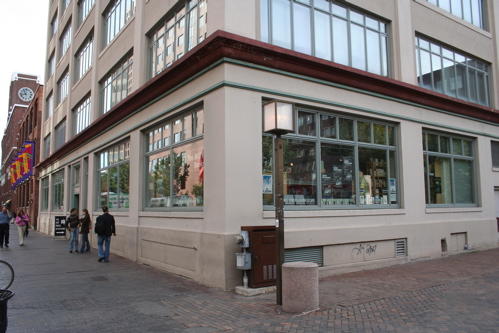
MIT press bookstore - ah, the temptations


Of all the wonderful bookstores on earth the MIT press bookstore at Kendall square in Cambridge is probably the one I like the best.
Small, compact, packed with way too much interesting information – so much I’d love to know. I can easily spend an hour browsing – and even swing by again the next day.

What I got:
Felice Frankel; Envisioning science
O’reilly’s magazine Make
Vital signs 2005 from Worldwatch institute
Sean Carroll; Endless forms most beautiful – the new science of evo devo
John Thackara: In the bubble

There was much more, I could have gotten. It takes tough discipline and prioritizing. I have to carry it home, and I have to read it. And who knows what other great books I may stumble upon in the coming days?

Tuesday, September 20, 2005

Self expression - or survival

A few postings ago I ranted about how what's considered "technology" varies between the developed and the developing world. Another observation about that:
Recently at Danfoss universe we had professor Neil Gershenfeld from MIT's Center for Bits and Atoms visit us and talk about his "fablab" concept.
His observation was that in developed countries, the fablabs would be used by people who created stuff they need: spare parts, some sort of sensor, a better machine for their work - practical things for daily survival.
At the fablab in Boston and at his classes at MIT, the lab would be used for self expression; art projects, weird non-rational ideas.
To me, the important part is that it's all very creative and no matter if you are creating to survive or creating to fight boredom, you need to get some basic understanding of the tools and the principles of constructing things in order to make an idea physical.
But it underlines the differences in how we approach technology in different parts of the world.

Big green

So GE is going green - or, at least they're making a big splash with their new Ecomagination theme..
In a way I would love to think that they are serious about their commitment, I really hope that they have realized that they can play a decisive role in changing the course away from destruction. But then again, it's hard not to be a bit cynical about corporate greeenwash.
There are some weird, but no doubt carefully calculated, touches to their website. It shows CEO Immelt and others talking to us, set in an abstract landscape held in earthly green and brown colors. There are trees, birds, water - and then an airplane crosses the sky in the background. I guess it's meant to show that planes are as natural as birds.
Another part of the flash animation shows a big cruise ship making it's way in the background. GE assures us: planes and cruise ships will not go away, even if we try to save the planet.

GE presents some amazing statistics and predictions, quoting the UN:

Registered autos in 1990: 560 mio.
- in 2010: 940 mio.

Oil consumption in 1990: 24 bio. barrels
- in 2010: 38 bio. barrels

Soft drink consumption in 1990: 364 mio. barrels
- in 2010: 765 mio. barrels

Municipal waste in 1990: 420 mio. tons
- in 2010: 860 mio. tons

Monday, September 19, 2005

So you think you can tell

An amazing quote from Shell's scenario planning division in their 2001 scenarios "energy need, choices and possibilites 2050":

”Technology improvements are likely to outpace rising depletion costs for at least the next decade, keeping new supplies below $20 per barrel.
The costs of biofuels and gas to liquids should both fall well below $20 per barrel of oil equivalent over the next two decades, constraining oil prices”.

...This is the worlds' largest oil company and its very well qualified scenario division speaking.

Wednesday, September 14, 2005

Wrecking the world for trinkets


There’s a certain genre of products that I vigorously hate. The stuff you buy in gift shops, or in the kind of surplus stores where every item in the store costs a euro or two. Cheap toys, cheap tools, decorations, colorful blinking gadgets.
At every birthday you end up with a heap of these items. Trinkets, little curiosities, jokes. A pen radio, a weird looking plastic sculpture, a set of screw drivers...
My problem with it is that in one sense these things are not cheap at all. There’s a price. You get a clear sense that behind each of them, there’s some horror story of dreadful working conditions, toxic materials, and poor people slaving at miserable salaries.
How else can you make money on transporting an item all the way here – where somebody still is able to make money on it, though it only costs a couple of euros.
Another reason I get upset is this whole idea of producing stuff so cheaply that it doesn’t really ever work. Tools that are so imprecise and cast from soft iron so soft you can’t do anything with them. Toys that only work for a few minutes, ”funny” figures of plastic that are fun for a moment – and then gather dust. What are we teaching our kids by giving them this crap?
Items made of finite or toxic materials, wrapped in even more materials, shipped across the globe, giftwrapped – all this, just to proceed straight to the junkheap.
I get the feeling that we are wrecking the world for trinkets.

Outlook - the game


On several occasions lately, I’ve been trying to explain why MMOGs (yes, Massively Multiplayer Online Games) are interesting to study as an indicator of how we will cooperate, socialize, trade, create and seek information in the years ahead.
The hard part part is the ”game” word. Games, and computer games in particular, carry a lot of stigma. Many see it as exactly the opposite of the kind of interaction and participation they would like to see.
It seems to help if you describe the ubiquitous Microsoft Outlook as an MMOG. We don’t think of it as playing a game, but we do spend hours in that environment, dealing with lots of players, some of whom we build up quite close relationships to online. Like an MMOG, Outlook is something you build up, it’s persistent and dynamic, even if you’re not yourself online. There’s considerable creative possibilities, you can trade, exchange information or products, you can co-create, you can have pranks and challenges.
But of course, there’s not much in terms of graphics, no avatars, no soundtrack – yet...

Saturday, September 10, 2005

Jetplanes and guilt

No doubt that airplanes consume lots of fossil fuel and generally mess up the atmosphere in a major way. Nevertheless, travelling is hard to avoid if you wanna get anywhere.
My good friend Adam has heard my scruples about flying for years. He pointed me to this article from OnEarth Magazine which tells about a number of organisations that will plant trees for you to offset the effects of your flying.
For instance, a round trip from San Francisco to Shanghai will produce 2.2 tons of carbondioxid emissions. This can (in some more or less abstract sense) be offset by planting three trees or changing three ordinary light bulbs to energy saving ones. Depending on what organisation you choose, for around $20-40 you can have them plant the trees or install lightbulbs.
Among the organisations are American Forests, which have an online Climate calculator that will give you a sobering view at the side effects of transportation.

Tuesday, September 06, 2005

Warhol - we miss you


Just some pretty flowers - and a touch of photoshop

What's the right question?


There’s plenty of concern about the lack of interest and knowledge about technology and natural science among children and students. However, it’s a little hard for me to see exactly where the problem lies. For instance, The ROSE study, which has asked a huge number of children all over the world about their interests in science, clearly shows that children in the richest countries have the least interest and respect for science.
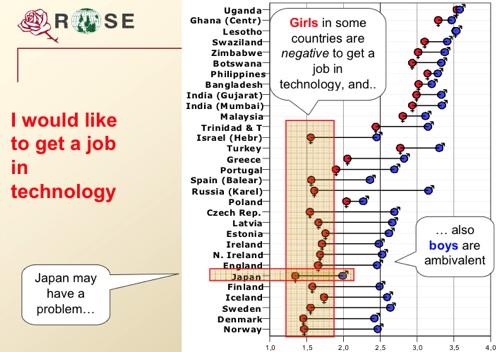
A particularly telling statistic is this figure, which I have taken from a presentation by Norwegian professor Svein Sjöberg who leads the Rose study.
Kids were asked if they would like to get a job in technology. This is very appealing to kids in countries like Lesotho, Uganda or Zimbabwe, whereas kids are increasingly negative the richer the country the come from is. The least interested in a technology job are Japanese boys.
Other questions in the study show pretty much the same attitude to science and technology.
Now, does this mean that Japanese boys don’t care about technology? I doubt it. It’s hard to think of anyone who are more inundated by technology than japanese boys. They live in a world that is nothing but technology, and mastering technology determines how well they can participate socially in society.

Technology in Osaka is not the same as in Kampala. The japanese boy may not be interested in basic technology, because it is not relevant and immediately necessary for him to know about it in the same way that it is for someone in Uganda.
You miss something very important if you don’t realize that the japanese boy is very likely to have an expert knowledge in technologies like sharing files, surfing and downloading, choosing the right shoe for athletics or the set of headphones with just the right sound. But it could very well be that this is not ”technology” to him – it’s just the way the world works.
Maybe we need to ask the question in a different way in order to understand what relation students have to science. I bet it would turn out to be a lot more sophisticated than current studies show.

Wednesday, June 22, 2005

No, you're too fat to drive

My daughter (14 years) was talking about how she would like to have a moped or a car so she could just drive around effortlessly. We then talked about how fat she would get if she didn’t get to walk and bike.
Her solution: a moped, or Segway of sorts, that would measure your body fat index and refuse to drive if you were getting too heavy.
I could see some interesting scenes with people trying to argue with their Segway or hacking it to give ’em a ride.

Gentlemen, start you engines


5xgrill
Originally uploaded by Peter Hesseldahl.

It's time to get out the grill before winter strikes again.

A public private sphere

The computer screen is an interesting mix of a public and a very private space. You know the situation: Someone is showing you something on their computer or you are doing a search together, and inevitably all sorts of little private bits come up. The browser shows what other URLs have been visited, The bookmark bar gives an idea of where the person usually goes to hunt information, Google reveals what other searches have been done.
The latest version of Apples Safari browser (2.0) has a feature called ”private browsing”. This is how Apple describes it:
”When private browsing is turned on, webpages are not added to the history, items are automatically removed from the Downloads window, information isn't saved for AutoFill (including names and passwords), and searches are not added to the pop-up menu in the Google search box”.

I like that, It really annoyed me that I couldn’t control what information I revealed about myself to anyone who I might be collaborating over the screen with.
But in fact, it’s more or less just returning to how things used to be. It would seem smarter if you could opt for an in-between solution. Keeping the data, but only showing them if you specifically need to. History data can be very usefull – and very revealing.

One more thing, sort of on the same subject: I hate it when powerpoint presentations end, or when you have to skip from one presentation to the next, and the whole crowd gets exposed to the desktop clutter. It’s like seeing people in their underwear, it can be interesting, a voyeuristic thrill, but basically it damages concentration on the topic you were supposed to focus on.

Thursday, June 09, 2005

Phone booth without a phone


finnish_phone_booth_crop_500
Originally uploaded by Peter Hesseldahl.

Nice touch. Where else but in Finland would you find a phone booth in trains without a phone? Or rather: In Finland, why would you want a phone in a booth for phoning - everyone has a phone in their pocket already.
Somehow significant; the way technology changes the architecture of the space we inhabit.

Friday, June 03, 2005

Bad energy forecast

Once again I walk away from a conference rather disturbed by what I’ve heard, but still professionally conscious that there are so many other schocking facts that we never really have the time to deal with.
Once again, an hour long barrage of powerpoints with curves all pointing in the wrong direction. You sit there, hoping for one of the speakers to finally pull out a solution. But no.

In this case an international conference on future energy consumption and supply at the national Danish research center Risø.
One speaker, Fatih Birol from IEA, the International Energy Agency, laid out the forecast with considerable institutional authority.

Among the conclusions of the IEA:
- Global energy cosumption will rise 60 % until 2030
- Almost all of the growth will be in the developing world
- There will be NO decoupling of energy use and carbon dioxide emmisions (in other words, the climate is screwed)
- As the oil wells of the EU and US run dry, a dramatically increasing share of the worlds energy will be supplied be a handfull of rather instabil countries, notably Saudi, Russia, Iran, Irag, and Nigeria.

Wednesday, June 01, 2005

Where am I?


IMG_7565_crop_500
Originally uploaded by Peter Hesseldahl.

Just a striking scene. A Danish-Japanese festival at Egeskov slot, one of the arch-typical historical castles. So here’s a women in Kimono who’s travelled from Japan to watch Danish kids playing traditional Japanese music. I realize that this mix of culture probably wouldn’t even be noticed in so many other places. In Denmark this is still a budding future.

A new kind of roadkill

Weird thought: Driving through the countryside you see the warning signs of deer and other wildlife crossing – and certainly on the roads there’s a variety of flattened animals on display.
When will they start putting up signs on the roads in metropolitan areas warning against stray robots, hurtling themselves more or less mindlessly into the traffic?

Communism 2.0.

I could see it happening at some point. So many of the technologies that we believe – on balance – promote freedom rather than control, could be turned against us as individuals, presumably for the sake of the greater common good.
Our world is becoming transparent, on record, searchable. Typically what we we’re getting is greater freedom, but greater responsibility and accountability, too. At the moment we don’t really have to think too much about the responsibility part – not in a fundamental sense, like in terms of water, energy or food.
Rather often, though, when you look ahead, the prognosis looks like major crunch. Getting through a period of true crisis could change the technological balance dramatically. If things get tight, it would seem very easy to slip in the directions of a lot more control and disciplin. Not necessarily enforced from above as such, rather a general feeling that everyone should pitch in, that we can’t tolerate hogging ressources or behaving in a blatantly anti-social way. Central planning and common standards could be enforced like never before. Hitting the wall in terms of ressources we would face an installed instrument of pervasive control. It might even work – but I’d rather that we find ways to maintain some slack in time.

Back to the middleman

I may be the last person discovering this, but just in case you haven’t heard: Sending your digital photos off to a real photo printing shop is simply vastly better than using a printer at home. You get that nice glossy and saturated quality that we used to get with film. God knows I’ve tried at home; with the best paper, fresh ink cartridges, maximum rendering quality, but it never really gets near to what sending your photos to a real printing shop can achieve. Find some service, mail you files, pick ’em up a few days later. It’s cheaper too.

Friday, May 06, 2005

Danfoss Universe - open for business!

Yes, finally, we're open. It's been a frantic effort in the past weeks, but everything is pretty much ready and up & running. Yesterdays' grand opening featured The crown princess and princess + other assorted royaltyi and lots of Very VIPs. Having 2500 guests in the park wnt a lot more smoothly than we had expected.
For my part, I've been coordinating the website - here, take a look.

Sunday, May 01, 2005

Climate change: now you see it

I happened to come across this amazing collection of very telling images which show glaciers retreating, snow melting, high tides etc. Climate change at it's most visible.