Wednesday, April 23, 2014

Podcasts with Pikkety


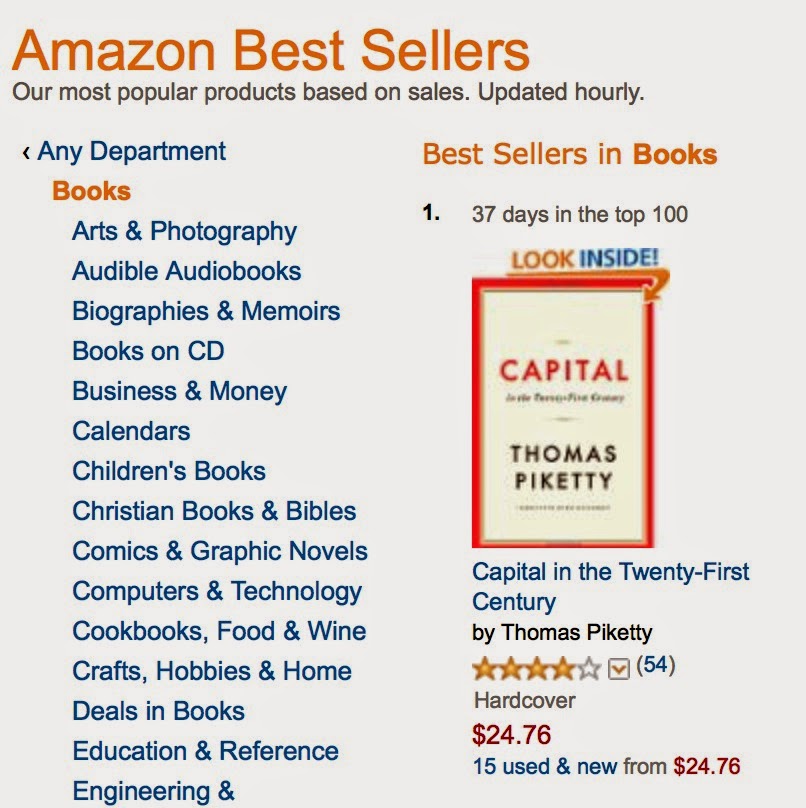
Thomas Pikkety’s book “Capital in the 21st. century” seems to be the must-read of the moment. It is central to the raging discussion about in-equality, and amazingly, the current top seller on Amazon.
However, it is also 700 pages long.
I’ve only found a few podcasts with Pikkety:
This is a 50 minute presentation, which give a good introduction to his core concepts.

This is a 40 minute video-interview with Huffington Post:


Among Pikkety’s main points are that the main factor determining the degree of in-equality is the ratio of income from capital vs. the overall rate of economic growth in society.
The larger the returns on capital are, the more those that have wealth already, will gain relative to those that get their income from wages.

At the moment, there is confluence of several trends, which are driving in-equality to levels that are as bad as in the 1920ies:
Financial services and stock markets are producing an ever-larger share of all the economic growth – but mainly to those that have the capital to invest. Automation and advanced technology makes income from capital intense industries more important, while labour intensive sectors contribute less. Growth in the economy that is based on wages is stagnant.
Furthermore, the demographic trend towards a falling population means that inheritance becomes more important, since the wealth of a person is divided among fewer children. Also, lower population growth or declining populations causes lower overall economic growth in society.


Pikkety believes the polarization will grow further, and he believes that it is de-stabilizing. He says that some inequality is good, but beyond a certain point, it’s simply excessive. The solution he proposes is a sharply progressive tax on property.

Tuesday, April 08, 2014

The sharing economy should be renamed

I'm all for the sharing economy. I am sure that mobilizing idle resources and sharing them is a way to create more value for less. But parts of the sharing economy is rapidly moving away from the local, person-to-person exchange with an emphasis on the social value of interaction. Instead, some services are becoming billion dollar companies, which happen to operate platforms for sharing, but are driven with a much stronger emphasis or even a starting point in accumulating money.

I think that coordinating exchanges is a perfectly valid business model, but the ideological facade is starting to look a bit deceptive. My inner cynic rises when I see videos like this one, from Peers.org - it's pretty thick, IMHO:


I am not alone in feeling that the "sharing" part of this new economy might be a misleading word. Personally, I prefer the "We-economy" or "The participatory economy".
Tom Slee, a Canadian blogger, regularly writes scathing posts describing what he sees as the hypocrisy and even sinister aspects of the sharing economy.
The tone is a bit harsh, but I'm with him for long stretches:
Check his post: Why the sharing economy isn't
or: Some obvious things about internet reputation systems


Monday, March 24, 2014

Hvad vil du leve af, når robotterne overtager dig arbejde?

Jeg anmeldte Brynjolfsson og McAfee's glimrende bog "The Second Machine Age" i Politiken. Den er bestemt værd at læse. Det er et af de store paradokser vi står overfor: Vi udvikler os derhen, hvor vi selv (eller rettere: størstedelen af os) bliver overflødige. 
Det kunne være rart at have en håndfuld troværdige forslag til løsninger.


Monday, March 17, 2014

Thursday, March 13, 2014

Video-foredrag om scenarie-metoden

)


I forbindelse med “Young Digitals” arrangementet i Sønderborg indspillede jeg fornylig et videoklip, hvor jeg forklarer den grundlæggende metode bag scenarier - et af fremtidsforskningens væsentligste værktøjer. 

I det her tilfælde handler det om at undersøge udsigterne for brugen af teknologi i fremtidens undervisningen, men scenarie-metoden kan bruges til alt mulig andet. 

Wednesday, January 22, 2014

Suddenly, money doesn't work


The Dankort system, the almost universal card payment system in Denmark, is down this morning. It’s mindboggling to think of all the small and large disruptions this creates – paying for transportation for instance.

It’s striking that with such large systems, you get equally large disruptions. Suddenly, in a glitch, money in general is out of order. That’s huge. Enough to make you consider carrying cash around. But then again, you can’t pay for a train ticket using cash at my station.  

Scaling your business in China - how to handle growth


In the Universe Foundation’s “Suitable for Growth”-project, we just published the latest issue of our newsletter on business in China. This time we focus on Scaling: What happens when you start growing? How do you keep in control, what kind of organization do you need, what are the dangers that can get you into trouble?

Good advice from the CEO’s of Radiometer and House of Amber.

Thursday, December 19, 2013

Robert Reich on Inequality for all

Robert Reich continues to deliver some of the most lucid analysis of the economic development. In this funny and thought provoking speech in the Commonwealth club of California he discusses the theme of his recent film, Inequality for all.
You ought to hear it. 

CEO of GE Healthcare discusses the need for frugal innovation

The CEO of GE division for healthcare, John Dineen, gave a very interesting keynote speech at the recent World Innovation Summit for Healthcare in Qatar. You can see the videorecording at the WISH website.
Among his observations were that GE traditionally has focused on taking their devices to the next level technically. But now they need to be as concerned about bringing costs down and making their products accessable in emerging markets. The coming years will be about Quality, cost and access, Dineen said. He also said that GE needs to be both clinically and economically relevant.

An example of a lower cost product from GE is a new orthopaedic MR scanner, which only scans limbs, so patients are not completely inserted in the scanner. It’s much more compact, less intimidating to the patients, and the price is $500.000 – rather than $2 million for a full blown MR scanner.


Another example is the smartphone sized V-scan, a battery driven, handheld and extremely easy to operate scanner, which sells for around 8.000 euros. It’s sold to doctors that do house calls in Japan, as well as to midwives working in African villages.
John Dineen observed, that selling to emerging markets means that GE needs to change their business model from simply selling devices, to taking part in creating an entire local eco-system of trained personal, maintenance, electrical charging etc.

Friday, November 08, 2013

Mine or our? They are very different games


There is an important difference between mine and ours, when it comes to commitment and roles. It makes a big difference whether it's ”my” project or if its ”our” project – and exactly the same is true for a company or organization, for knowledge, for stuff and gadgets, and for profits ... Are you thinking in terms of ”me” or ”we”? They are different games, with different logics. And my argument would be that we are moving towards more of an ”Our” approach, ​​because it pays off better with the tools we have available, and because it works better with the challenges we must overcome these days. 
If it's ”your” project, well, that's what it is - then it's not mine, and it’s not any of a lot of other potential contributors’. That makes a difference, and we should be aware of its implications.

Tuesday, October 08, 2013

SfG Newsletter: Consumer insights in emerging markets

-->
How do you understand customers in places that are very different from your home-market? Brilliant companies like Toyota, MacDonalds and Danish fashion company IC-companies have failed to connect to the Chinese consumers, thinking that they could simply push the same products that were successfull in the West.

The latest newsletter from the ”Suitable for Growth” project at the Universe Foundation focuses on how to collect market insights in emerging markets, for instance by using ethnographic observations and organizing insights in ”Customer journey maps”.

It also offers lots of entertaining examples of cultural quirks and surprises collected in China. And it features a rare insight into how Haier, the Chinese white goods manfuacturer, uses customer understanding as its core competitive advantage.

It's obvious - if you can see it

-->

Jan Chipchase is probably the worlds leading consumer anthropologist. He has spent decades travelling the world doing consumer research for companies like Nokia, diving deep into local cultures, following consumers in their homes and at work.

In his book ”Hidden in plain sight”, Chipchase presents his methods and how companies use his observations to win customers, even in the most foreign markets and cultures.

His website is a wonderful and ever-changing collection of his snapshots and observation from criss crossing the world – China, Libya, Japan, Afghanistan... -   in search of insights that can lead to better products.


It’s obvious: If you want to create suitable products, you need to know your customers well.

Jan Chipchase is probably the worlds leading consumer anthropologist. He has spent decades travelling the world doing consumer research for companies like Nokia, diving deep into local cultures, following consumers in their homes and at work. Today he is head of consumer insight at Frog, a leading American design company.

In his new book ”Hidden in plain sight”, Chipchase presents his methods and how companies use his observations to win customers, even in the most foreign markets and cultures.


The inspiration that Jan Chipchase collects is anything but linear and direct. Seeing a child by the roadside in Ho Chi Minh City selling gasoline to scooter drivers from a large bottle placed on a stack of bricks, and using a simple plastic hose to fill the scooters’ fuel tank, Chipchase realizes that this is the absolute minimum of what a gas station can be.

He uses the observation to start thinking about what a gas station would be like if it didn’t even sell gasoline. In an age of electrical cars, which can charged when people park at home or at their job, what services remain for the gas stations to deliver: bathrooms, food, car service, picking up parcels? How do gas stations make a difference when the gas is gone?


Building trust

Noticing that in some places, consumers making a cup of tea will sniff the milk before they pour it into the cup, Chipchase starts wondering about the many ways that companies need to build trust in their brand by allowing users to ”sniff the milk” before they buy.

How to signal trust, reliability, status varies tremendously between cultures – and understanding how to meet the locate requirements and style of communicating quality is crucial – for instance, if you are selling milk, chicken or beer in China.

A Chinese example of building trust is the use of carpet mats in elevators, and seat coverings in taxis with the current day of the week printed on them – a way to show customers that this is a clean place.

One reason why Ebay has failed, but Taobao has succeeded in China, is that Taobao allows customers to put the payment into an escrow account at Taobao. Sellers know that the money has been deposited, but it will only be released, when the customer has received the goods and is satisfied with them.


No-one wants to be seen as disabled

A particularly interesting case, which Chipchase describes in his book, is the process, Nokia went through when it considered whether to create a handset specifically suited for illiterate users in developing countries.

Nokia has a very strong brand in developing and emerging markets. Of the more than a quarter of a billion phones it sells annually, a large part are the simplest and cheapest model, and millions of them are sold to people who are illiterate.

Chipchase and his colleagues did extensive research into how illiterate people use phones and services such as texting or receiving information. They realized that illiterates do not want to carry a phone, which clearly signals that they have no education. People have invented all sorts of work-arounds that allow them to use the phone despite not knowing letters and numbers, so for them, the most important factor was that the phone is cheap and reliable.

The surprising conclusion for Nokia was, that it would be better to continue selling one, really cheap phone, rather than developing and marketing a new model, which would inevitably be more expensive.

Therefore, Nokia decided to focus its efforts on designing little changes to the general interface that could help the illiterate.


Go out and live with people

A lot of Chipchase’s work has been helping Western companies understand what consumers in the emerging markets become willing to pay for as their buying power increases.

He repeatedly emphasizes that ”low-income people are in fact some of the worlds toughest customers. Because they have to make every rupee count, they can least afford to buy poorly designed products”.


”Hidden in plain sight” is also a bit of a manual. Chipchase describes how he and his teams start their scouting in a new location by finding local helpers – ”fixers” – often students, who can take them for tours, explain local quirks and set up meetings in private homes and companies.

Rather than staying at a hotel, Chipchase prefers renting a house for the whole team to live in, and he recommends renting bikes, to get a closer feel for the city’s flow and life. He likes to wake up early to observe the city coming to life; unfolding the functions, rituals and habits of everyday life.

Barbershops are one of the places he visits to get into conversations that go deeper than an outside observation. He confesses, that he has managed to take a shave twice in a day, just to meet more people.


It’s all about looking at the world with a systematically open and curious mind: Visiting people in their homes, sneaking a peek in their refrigerator and bathroom, joining them on their commute to work, studying what they carry in their pockets and bags, and asking why they carry it.  Weeks of observations lead to a better sense of how people consume, in order to make their lives more convenient and maintain the social status they strive to express: whether it be through the use of mobile phones, banking services or deodorant and toothpaste.

In Bangkok, Chipchase found a shop selling false braces for teeth. The cheap braces obviously were not working, but they were worn by people who wanted to signal that they had the means to have their teeth straightened.


Find a problem and fix it

It becomes clear from the many examples in the book how blockbuster products and service have emerged, because someone realized, that there was an everyday problem, which could be fixed – but which, as the title of the book has it, had been hidden in plain sight.

A simple insight into how users behave allows designers to come up with improvements – big or small: Google understood that we often forget to attach files when we mail others, so in Gmail, if you use the word ”attach” in your message, and you don’t attach a file, the system will ask if you want to attach a file, before sending.


What’s suitable for customers is not always obvious, there is any number of ever-changing  dimensions and variables to consider and weigh against each other. Jan Chipchase’s book will give readers a good introduction to some methods that can business choose with more precision.


Chipchase'sblog, future perfect, is a treasure trove of funny and thought provoking observations from around the world.

Monday, September 23, 2013

Syret tænkt, smukt udført

Vores lokale kunstgalleri i Svendborg, SAK, har en ny udstilling med en stribe af de gamle rock-musikere, som har kastet sig over billedkunst på deres gamle dage: Troels Trier, Erik Clausen, Franz Beckerlee etc. Det er ganske finurligt, men når det kommer til virkelig at kunne tegne, så rager Ole Fick langt over resten. Det er både mesterligt udført - og temmelig syret tænkt. Check hans website. 

Wednesday, September 11, 2013

Glassholes and drones

-->
Drones and Google glasses may be a lot of fun for the person controlling them, but for everybody else they are likely to be a nuissance. 
They are technologies whose use obviously affects others. Being allowed to use them at a given location is not just a matter of individual freedom, since using them affects the freedom of others not to feel spied on, or not being disturbed by the buzzing overhead. 
It will be interesting to see how it plays out. How will we enforce drone or glass – free zones?

Monday, September 02, 2013

Fake goods galore

Wonderful set of photos from a high-end shopping mall in Shenyang, China - with Fake brand names: Starbocks, Cnanel, Herwes, Cairter etc.
Via: Offbeatchina.com


Newsletter on Chinese mid-market; Relations between HQ and subsidiary

To what extent should the subsidiary in China be allowed to act differently than the mother-company in Denmark? It’s a delicate balance: The Danish headquarter needs consistency and
coordination among its divisions – but the subsidiary in China needs freedom and resources to pursue opportunities in a rapidly changing market.
The latest newsletter from the Suitable for Growth project at the Universe Foundation focuses on how to manage that balance.

Friday, August 23, 2013

No growth for them: 40% of Britons are falling behind

The Economist published an informative article, describing how any economic recovery so far has only benefited the wealthy. Wages have barely risen since 2000, but living costs are 35% higher.
52% of Britons are struggling to keep up with the bills. 
Makes you wonder how far the polarization of income will go, before the trend reverses?

Wednesday, August 21, 2013

Frugal solutions presention at AOM 2013 in Orlando

I presented the frugal solutions project at the Academy of Management annual conference in Orlando. The presentation focused on why frugal innovation is highly relevant for Western markets.
You can see the slides and listen to the 15 minute presentation here.